

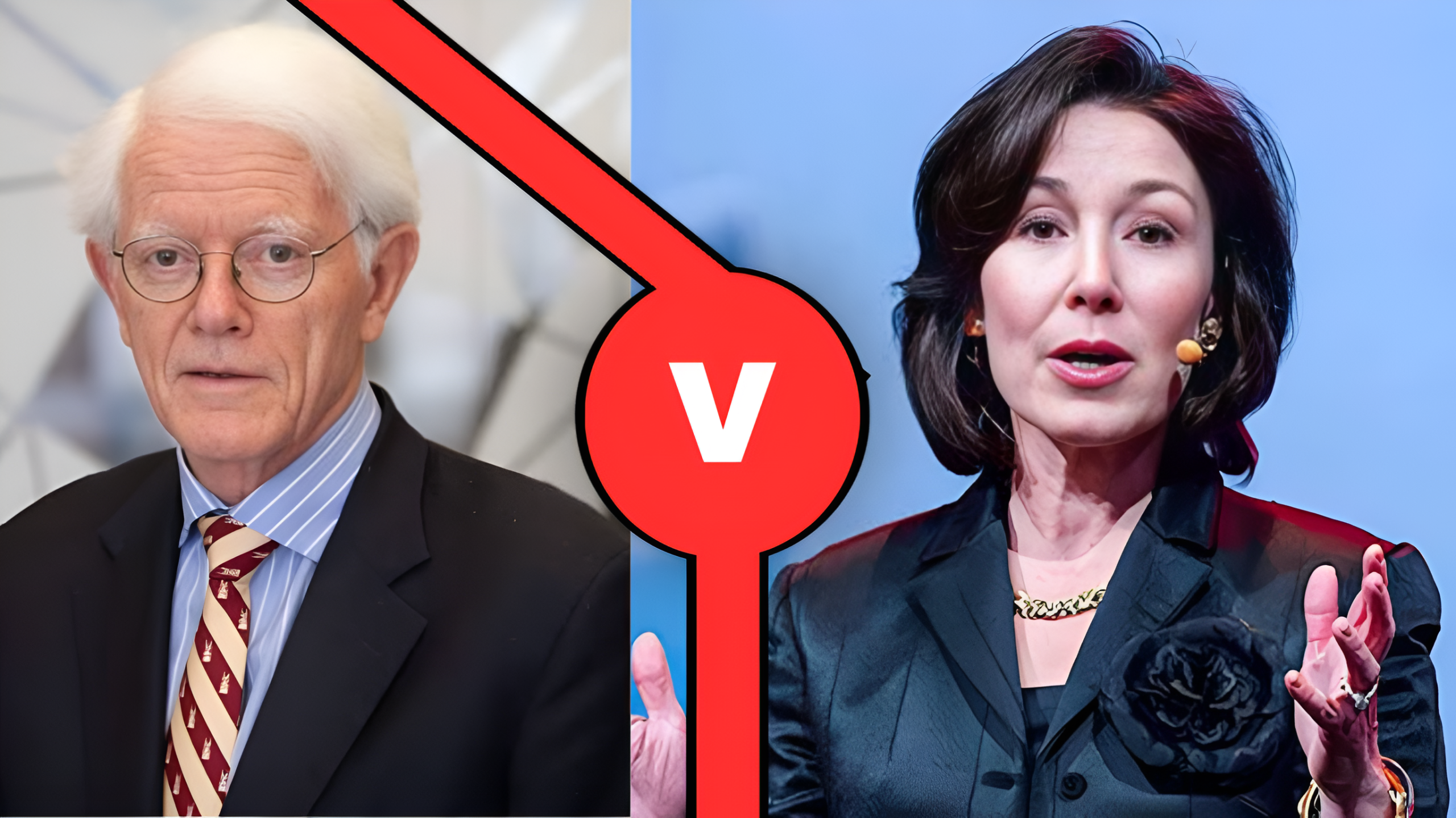
Put Peter Lynch and Safra Catz beside each other and the connection isn’t immediately obvious.
Lynch is remembered for picking stocks.
Catz spent decades helping run Oracle.
One became famous for deciding which companies were worth owning a piece of. The other built much of her reputation helping decide when Oracle should spend billions to own the whole thing.
There is, however, a genuine link between them.
Both went to Wharton.
Peter Lynch is a member of Wharton’s graduate class of 1968. Safra Catz earned her undergraduate business degree there in 1983 before receiving her law degree from the University of Pennsylvania in 1986. They attended roughly 15 years apart, so they were not classmates.
Beyond that shared university background, reliable public records do not establish a significant personal partnership between Peter Lynch and Safra Catz.
And that’s where this story gets more interesting, because their separate careers ended up asking versions of the same expensive question:
How much is a business really worth?
They just had to answer it from opposite sides of the table.
Peter Lynch and Safra Catz at a Glance
| Detail | Peter Lynch | Safra Catz |
|---|---|---|
| Best known for | Managing Fidelity’s Magellan Fund | Longtime leadership at Oracle |
| Wharton connection | WG’68 | W’83, L’86 |
| Main financial role | Portfolio manager and investor | Corporate executive and former investment banker |
| Defining period | Magellan manager, 1977–1990 | Oracle CEO, 2014–2025 |
| Current/recent role | Vice Chairman, Fidelity Management & Research | Executive Vice Chair, Oracle Board |
| Main capital decision | Whether to own shares in a company | How Oracle should deploy capital, including acquisitions |
| Documented partnership together | None established | None established |
Fidelity’s own historical records list Lynch as Magellan’s manager from 1977 to 1990. Oracle’s current records identify Catz as Executive Vice Chair after her September 2025 transition from CEO.
What Is the Connection Between Peter Lynch and Safra Catz?
The clearest documented connection is educational.
Both are Wharton alumni.
Lynch graduated from Wharton’s MBA program in 1968. Wharton publications identify him as Peter Lynch WG’68.
Catz is identified by Wharton as W’83, L’86. She earned her undergraduate degree from Wharton and then completed her law degree at Penn. In 2018, she returned as one of Wharton’s graduation speakers.
But sharing an alma mater should not be turned into a relationship that the evidence doesn’t support.
There is no reliable public record establishing that Lynch and Catz were classmates, colleagues, business partners, investment partners or mentor and student.
Their time at Wharton didn’t even overlap.
The university is the link.
The careers came later—and separately.
Are Peter Lynch and Safra Catz Related?
There is no established evidence that Peter Lynch and Safra Catz are related by family.
Their published professional backgrounds follow separate paths, and neither Wharton, Fidelity nor Oracle presents the other person as a relative or significant personal associate.
That is worth stating clearly because a search containing two names often makes the relationship seem stronger than it is.
In this case, there is a legitimate institutional connection, but not a documented family one.
Did Peter Lynch and Safra Catz Ever Work Together?
No significant professional collaboration between them is established in the authoritative records I reviewed.
Lynch’s defining professional chapter was Fidelity. Catz’s was Oracle, after an earlier career in investment banking at Donaldson, Lufkin & Jenrette. Oracle says she joined the company in 1999.
By that point, Lynch had already been out of the Magellan manager’s job for nine years.
Fidelity records his tenure as running from 1977 through 1990.
That timeline doesn’t rule out every possible social encounter between two prominent business figures. It does rule out the idea that they built their best-known careers side by side.
They didn’t.
Peter Lynch Was Paid to Say “No” to Most Companies
People often remember Peter Lynch through a handful of memorable investing ideas.
Look for businesses you can understand.
Pay attention to companies encountered in ordinary life.
Do the research yourself instead of treating a good story as sufficient evidence.
Fidelity still describes Lynch’s approach as using specialized knowledge to generate investment ideas, followed by analysis to determine whether the stock is actually worth owning. Fidelity also associates him with the idea of combining growth and valuation rather than pursuing growth regardless of price.
That last part matters.
An investor can admire a business and still dislike its stock price.
A wonderful company purchased at an absurd valuation can be a poor investment. A dull-looking company whose economics are improving can be much more interesting than its public image suggests.
Lynch’s job therefore wasn’t simply finding “great companies.”
He had to decide which companies were worth owning at the price available in the market.
And most companies had to receive a no.
The Scale of Magellan Changed Dramatically Under Lynch
Lynch managed Fidelity’s Magellan Fund from 1977 until 1990.
Fidelity’s historical fact sheet puts the fund’s assets at roughly $20 million at the beginning of his tenure. The beginning asset figure for his successor is listed at approximately $14 billion, showing how dramatically Magellan expanded during the Lynch era.
Boston College describes Magellan during his tenure as the top-ranked general equity fund in the United States and notes that Lynch later became known to a much wider audience through books including One Up on Wall Street and Beating the Street.
That second career mattered almost as much to his reputation.
He didn’t only manage money.
He explained investing in language ordinary people could follow.
Safra Catz Started Much Closer to Wall Street Than Silicon Valley
Safra Catz’s eventual identity became inseparable from Oracle, but she didn’t begin her career inside a software company.
Before Oracle, she worked at investment bank Donaldson, Lufkin & Jenrette, where Oracle says she held several positions including Managing Director in Investment Banking. She joined Oracle in 1999.
That background is important when comparing her with Lynch.
Catz wasn’t a technologist who slowly learned finance after reaching the executive suite.
Finance was already part of her professional foundation.
At Oracle she moved through senior vice president, executive vice president, president and chief financial officer roles before becoming CEO in September 2014. Oracle’s 2026 SEC filing records that she remained CEO until September 2025.
For more than two decades, she therefore sat unusually close to the intersection of finance, operations and technology strategy.
Peter Lynch Bought Pieces of Companies. Safra Catz Helped Oracle Buy the Companies.
This is the comparison I find much more useful than simply saying both understood finance.
Suppose Lynch liked a company.
He could buy shares.
If the facts changed, the valuation became unattractive or a better opportunity appeared, a portfolio manager could reduce or exit that investment.
Ownership did not give him operational control over the company.
Now imagine Oracle deciding to acquire a business.
That’s different.
The price may run into billions. The buyer inherits products, customers, employees, contracts and technical systems. Once the acquisition closes, the question is no longer simply whether the asset was worth buying.
Now it has to work inside the company.
Catz spent years making decisions in that environment.
The difference is subtle but enormous.
Lynch evaluated businesses while standing outside them.
Catz helped evaluate businesses knowing Oracle might have to absorb them.
The PeopleSoft Deal Shows Why That Difference Matters
One of the transactions most closely associated with Catz’s rise at Oracle was PeopleSoft.
Oracle announced in December 2004 that it would acquire PeopleSoft for approximately $10.3 billion.
A Wharton profile of Catz later credited her with driving the takeover and described the deal as a major step in strengthening Oracle’s business-software position.
For an outside investor, the analysis might focus on whether Oracle’s shares properly reflected the deal’s costs and future benefits.
Inside Oracle, the questions were much messier.
What should Oracle pay?
How much overlap existed between the companies?
Could costs be reduced?
Could customers be retained?
Could separate products and teams be integrated?
Would the deal eventually produce more economic value than the cash and effort required to complete it?
That’s capital allocation with consequences an investor doesn’t directly have to manage.
Then Came Sun Microsystems
Oracle agreed in 2009 to acquire Sun Microsystems in a transaction valued at approximately $7.4 billion, or $5.6 billion net of Sun’s cash and debt.
Catz, then Oracle’s president, said at the time that Oracle expected the acquisition to contribute significantly to operating profit.
Again, the interesting part isn’t merely the size of the number.
Buying Sun gave Oracle far more than another line on an investment statement.
It brought technologies, employees, customers and products—including Java—inside Oracle’s orbit.
For Lynch, owning a stock meant judging management.
For Catz, an acquisition could mean becoming the management responsible for what happened next.
That is a fundamentally different kind of bet.
Cerner Took the Same Question to a Much Bigger Number
During Catz’s CEO tenure, Oracle agreed to acquire Cerner for approximately $28.3 billion in equity value.
The deal closed in June 2022.
Catz publicly said Oracle expected Cerner to become a significant growth engine and expected the transaction to add to non-GAAP earnings.
Whatever one thinks about an acquisition afterward, the decision structure is revealing.
A portfolio manager can spread risk across dozens or hundreds of holdings.
A corporate acquisition of that size concentrates attention.
You don’t get to tuck a $28 billion operating business quietly into the corner of a portfolio.
People notice.
Employees notice.
Customers notice.
Shareholders notice.
And management has to make the original investment thesis function in the real world.
The Price Question Links Lynch and Catz Better Than the Word “Finance”
This is where their careers genuinely begin to rhyme.
Peter Lynch had to ask:
Is this company worth buying at today’s share price?
Safra Catz repeatedly had to help answer a harder variation:
Is this company worth buying at a price high enough to persuade its owners to sell it to us?
Those questions sound similar.
They aren’t.
An investor purchasing shares normally buys at the market price and takes a minority position.
A corporate acquirer often has to offer a premium, finance the transaction, integrate the target and justify the strategic logic for years afterward.
Lynch could be right about a company but wrong about its stock price.
A corporate buyer can be right about the target company and still destroy value by paying too much for it.
In both cases, enthusiasm is cheap.
Price discipline is the difficult part.
Did Peter Lynch Invest in Oracle?
This is a particularly interesting question because the timeline leaves room for it—but doesn’t prove it.
Oracle’s official investor information says the company went public on March 12, 1986, offering 2.1 million shares at $15 each.
Lynch was still managing Magellan at the time and continued doing so until 1990.
So Oracle was publicly traded during the final several years of the Lynch-led Magellan period.
That makes an Oracle investment chronologically possible.
But possibility isn’t evidence.
I found no sufficiently authoritative public record establishing that Lynch made Oracle a notable Magellan holding, and there is certainly no basis for claiming he invested in Oracle because of Safra Catz.
Catz did not join Oracle until 1999—nearly a decade after Lynch stopped managing Magellan.
So any supposed Lynch–Catz Oracle investment relationship falls apart on the timeline alone.
Safra Catz Is No Longer Oracle’s CEO
This detail is important for a 2026 article.
Catz became Oracle’s CEO in 2014 and held the role for roughly eleven years.
On September 22, 2025, Oracle announced that Clay Magouyrk and Mike Sicilia would become CEOs and that Catz would move to the position of Executive Vice Chair of the Oracle Board of Directors.
Oracle’s current board page still lists her in that position, and the company’s fiscal 2026 SEC filing confirms that she became Executive Vice Chair in September 2025.
This is one of the places where a new article can outperform older or loosely updated pages.
Calling her simply “Oracle CEO” in the present tense is no longer accurate.
What Is Peter Lynch Doing Now?
Lynch stopped running Magellan decades ago, but his association with Fidelity did not simply disappear when he left day-to-day portfolio management.
Recent Fidelity fund materials identify him as Vice Chairman and a Director of Fidelity Management & Research Company LLC, as well as a member of advisory boards for Fidelity funds.
His work has also extended deeply into philanthropy.
Boston College notes his long involvement in education and nonprofit work, including raising substantial scholarship funding for children in Greater Boston.
That makes his present public identity quite different from the intense 13-year Magellan period for which investors remember him.
Their Shared Wharton Background Is Real—but Their Careers Show Two Different Kinds of Judgment
It would be easy to make too much of the Wharton connection.
Business school did not produce identical careers.
It barely produced similar ones.
Lynch eventually became responsible for deciding which publicly traded companies deserved investors’ money.
Catz became responsible for helping decide where a corporation itself should place enormous amounts of money.
One could change his mind by selling shares.
The other might have thousands of employees still showing up Monday morning after a deal closed.
One judged management teams from the outside.
The other became part of the team shareholders were judging.
One generally bought pieces of companies.
The other helped Oracle buy entire companies.
Those differences are more revealing than any attempt to force the two into the same definition of financial success.
They Also Belong to Different Business Eras
Lynch’s famous Magellan run began in 1977.
That was before Oracle went public.
Before the commercial internet.
Before cloud computing.
Before smartphones.
And well before modern software companies reached today’s scale.
Catz’s Oracle years unfolded through a very different economy: enterprise software consolidation, the internet, massive technology acquisitions, subscription software, cloud infrastructure and eventually artificial intelligence.
Oracle itself illustrates the overlap between their eras rather neatly.
The company went public in 1986, while Lynch was still running Magellan.
Catz joined Oracle 13 years later, in 1999.
The same company therefore existed in both professional worlds, but at radically different stages of its life.
Would Peter Lynch’s Investing Ideas Apply to a Company Run by Safra Catz?
Not in a mechanical sense.
There is no credible evidence that Catz designed Oracle’s corporate strategy around Lynch’s investment philosophy.
But an investor applying Lynch-style thinking to Oracle would naturally care about things such as how the company makes money, whether earnings can grow, what customers actually need, what management is doing with capital and whether the valuation leaves room for a satisfactory return.
Those are investor questions.
Catz had to deal with many of the operating facts those questions depend on.
That’s the interesting divide.
Investors study the output of corporate decisions.
Executives create much of that output.
Lynch became unusually good at judging those results.
Catz spent decades helping produce them.
Frequently Asked Questions
What is the connection between Peter Lynch and Safra Catz?
Their clearest verified connection is the Wharton School of the University of Pennsylvania. Lynch is a Wharton MBA alumnus from the class of 1968, while Catz earned her Wharton undergraduate degree in 1983 and Penn law degree in 1986.
Are Peter Lynch and Safra Catz related?
No reliable public evidence establishes a family relationship between them.
Did Peter Lynch and Safra Catz attend Wharton together?
No. Lynch is WG’68 while Catz is W’83, L’86, placing them at Penn in different periods.
Did Peter Lynch and Safra Catz work together?
There is no established significant professional partnership between them. Lynch’s defining career was at Fidelity, while Catz joined Oracle in 1999 after working in investment banking.
Did Peter Lynch invest in Oracle?
Oracle became publicly traded in 1986 while Lynch was still managing Magellan, so the timing made an investment possible. However, I found no authoritative evidence sufficient to claim that Oracle was a notable Lynch investment.
Did Safra Catz influence Peter Lynch’s investment strategy?
There is no reliable evidence of such an influence. Their best-known professional periods were separate, and Catz did not join Oracle until 1999, nine years after Lynch stopped managing Magellan.
Is Safra Catz still Oracle’s CEO?
No. She stepped down as CEO in September 2025 and became Executive Vice Chair of Oracle’s Board. Clay Magouyrk and Mike Sicilia were appointed CEOs.
How long did Peter Lynch manage the Magellan Fund?
Fidelity lists Peter Lynch as Magellan’s manager from 1977 through 1990.
What was Safra Catz’s career before Oracle?
Before joining Oracle in 1999, Catz worked at Donaldson, Lufkin & Jenrette and held positions including Managing Director in Investment Banking.
What major acquisitions happened during Safra Catz’s Oracle career?
Her Oracle years included major transactions involving companies such as PeopleSoft, Sun Microsystems and Cerner. Oracle announced PeopleSoft at about $10.3 billion, Sun at about $7.4 billion, and Cerner at about $28.3 billion in equity value.
Final Thoughts
Peter Lynch and Safra Catz really do share something.
Wharton.
But that fact is almost the least interesting part once you look at what came afterward.
Lynch spent his most famous years trying to determine which companies were worth owning without having the power to run them.
Catz spent decades inside Oracle, where capital decisions could end with Oracle owning the entire company being evaluated.
A stock picker can study a business, buy a position and later change his mind.
An executive who signs off on a multibillion-dollar acquisition does not get such a clean escape hatch. The business arrives with its people, software, customers, problems and expectations.
That’s why the comparison works.
Peter Lynch became famous for choosing businesses from the outside.
Safra Catz became influential by making consequential decisions from the inside.
They learned business at the same institution.
What they eventually did with that knowledge could hardly have been more different.
Read More: Venzaro Magazine