






A broad head, compact muscular body and unmistakable black coat with rich markings make the Rottweiler difficult to confuse with most other dogs. The unusual word Rodwajlery has started appearing around the same breed in online searches, leading some readers to wonder whether it describes a separate variety of dog. The reliable breed records point in a much simpler direction. Rodwajlery is not listed as an independent breed by major canine organizations; the recognized breed is the Rottweiler, a German working dog with a long history of guarding, driving livestock and working alongside people.
What Does Rodwajlery Mean?
Rodwajlery is best treated as an informal online spelling associated with the Rottweiler rather than the official name of a separate breed. Several recent websites use Rodwajlery and Rottweiler interchangeably, which explains why searches for the unusual spelling now lead overwhelmingly to Rottweiler guides. What is much easier to verify is the official name. The Fédération Cynologique Internationale lists the breed as Rottweiler, identifies Germany as its country of origin and places it under Standard No. 147. The American Kennel Club likewise recognizes the breed under the name Rottweiler in its Working Group.
This distinction matters because unusual online terms can quickly begin to look more established than they really are. Once several articles repeat the same description, later writers may treat that repetition as proof. A person researching a puppy, training requirements, health screening or breed standards will get more dependable information by using the recognized name Rottweiler when checking kennel clubs, veterinary sources and established breed organizations.
Is Rodwajlery a Different Type of Rottweiler?
There is no recognized Rodwajlery breed standard separate from the Rottweiler standard. Major canine organizations do not list Rodwajlery as another breed, subtype or independently recognized bloodline. If a seller describes a puppy as a special “Rodwajlery breed,” that wording by itself does not establish that the dog belongs to a distinct canine category. The useful questions are still the normal Rottweiler questions: who bred the dog, what health testing was performed, what are the parents’ temperaments, what registration or pedigree information exists and how the puppies were raised.
Labels can be created easily. Genetic health, temperament and responsible breeding practices cannot be replaced by an unusual name. Anyone considering a puppy should therefore focus more on documentation and the breeder’s practices than on creative terminology.
The Recognized Rottweiler Breed
The FCI describes the Rottweiler as a medium-to-large, powerful dog with a compact build, black coat and clearly defined tan markings. Its breed standard emphasizes strength, agility and endurance rather than exaggerated heaviness. The standard also describes the ideal temperament as good-natured, calm in basic disposition, devoted, obedient, willing to work, self-assured and alert.
These characteristics help explain why Rottweilers have performed many different roles. They have been used for guarding, livestock work, service duties and companionship. Their strength attracts attention first, but physical power is only part of the breed. Intelligence, responsiveness to training and close attachment to people are equally important when understanding what daily life with one can be like.
Where Did the Rottweiler Come From?
The breed’s history is strongly associated with Germany and the town of Rottweil. The FCI’s breed standard traces the Rottweiler’s background to dogs used in Roman times for herding and driving livestock. As Roman groups moved across Europe, these working dogs traveled with them and later became associated with the Rottweil region. There they were used to drive cattle, protect people and property, and perform practical working tasks.
The American Kennel Club also describes the breed as descending from mastiff-type dogs connected with Roman livestock work, although historical origins this old are not documented with the precision expected from modern breeding records. The important point is that the Rottweiler developed as a working dog rather than as a purely decorative companion. That background still influences its temperament, exercise needs and training requirements today.
What Does a Rottweiler Look Like?
A well-bred Rottweiler should appear strong and balanced rather than excessively bulky. The breed has a broad head, substantial body, strong bone and a short black coat with clearly defined markings. According to AKC information, adult females commonly stand around 22 to 25 inches at the shoulder, while males generally stand about 24 to 27 inches. AKC lists the breed’s typical weight range at roughly 80 to 135 pounds, with males generally larger than females.
Size alone should never be treated as a measure of quality. Extremely oversized dogs may look impressive in photographs, but exaggerating body mass is not the goal of the breed standard. Structure, movement, health and temperament matter much more than producing the heaviest possible dog.
Rottweiler Temperament
Rottweilers are often described as confident, loyal and naturally watchful. They can form strong attachments to their families and may be reserved around unfamiliar people. The FCI standard emphasizes steadiness, self-assurance and alertness, while AKC guidance describes the breed as protective, intelligent and affectionate with its own people.
No short breed description can predict the personality of every individual dog. Genetics, early environment, socialization, training and handling all influence behavior. A stable Rottweiler should not be encouraged to react aggressively to ordinary situations simply because the breed has protective instincts. Good ownership channels those instincts through control, confidence and predictable behavior.
Are Rodwajlery or Rottweilers Naturally Aggressive?
Calling an entire breed aggressive is too simplistic. Rottweilers are powerful dogs with guarding instincts, and that means poor socialization or irresponsible handling can have serious consequences. At the same time, the official breed standard describes the desired Rottweiler as even-tempered and good-natured rather than randomly aggressive.
Owners should take the breed’s strength seriously without trying to turn the dog into something unstable. Encouraging suspicious or confrontational behavior may feel like “guard training” to an inexperienced owner, but a dog that cannot distinguish ordinary life from a genuine threat becomes difficult and unsafe to manage. Responsible protection begins with obedience, neutrality and control.
Early Socialization Matters
A Rottweiler puppy should gradually experience ordinary people, environments, sounds, surfaces, handling and appropriate dogs while still feeling secure. Socialization does not mean forcing the puppy into overwhelming situations or encouraging every stranger to interact physically. The purpose is to help the dog learn that normal parts of life do not require fear or defensive behavior.
AKC guidance emphasizes early socialization and training because territorial tendencies can otherwise become harder to manage as the dog matures. This is particularly important with Rottweilers because a behavior that seems minor in a small puppy can become much more difficult when the same animal weighs more than 100 pounds.
Training Should Begin Early
Training a Rottweiler should not begin when the dog is already large enough to pull an adult across the street. Basic household rules can start from the puppy’s first days at home. Teaching a reliable response to the dog’s name, recall, loose-leash walking, settling, leaving objects alone and calmly accepting handling creates useful habits long before advanced obedience becomes necessary.
Consistency matters more than intimidation. Rottweilers are strong dogs, but strength does not mean harsh treatment improves learning. Clear rules, appropriate rewards, repetition and well-timed consequences are more useful than confusing or confrontational handling. If serious behavior problems appear, an experienced qualified trainer or veterinary behavior professional can help assess the specific dog instead of relying on generic internet advice.
Mental Work Is Important Too
Physical exercise alone does not fully satisfy an intelligent working breed. A Rottweiler can finish a walk and still have plenty of mental energy. Short training sessions, scent-based activities, food puzzles, structured play and obedience practice can provide another type of challenge.
Mental stimulation does not need to be complicated. Asking the dog to wait calmly before going through a doorway, search for hidden food, practice a place command or work through a few minutes of obedience creates useful engagement. These activities also strengthen communication between dog and owner.
How Much Exercise Does a Rottweiler Need?
Rottweilers are active working dogs, but exercise should match the individual’s age, health and physical development. AKC guidance describes the breed as active and notes that Rottweilers generally do well with activities such as walking and swimming with their owners.
A young puppy should not simply be pushed through long forced exercise sessions in an attempt to tire it out. Growing joints need appropriate activity and recovery. Mature healthy dogs can usually handle more demanding walks and structured activities. Older dogs or those with orthopedic problems may need a modified routine developed with veterinary guidance.
Consistency is usually more valuable than occasional extremes. A dog that receives appropriate activity and engagement every day is often easier to live with than one that spends most of the week inactive and then receives one exhausting outing.
Rottweilers and Family Life
A well-socialized Rottweiler can be deeply attached to family members and may enjoy living closely with people. AKC describes Rottweilers as affectionate toward their families and notes that properly trained dogs can be patient around children. However, the breed’s physical size and enthusiastic play mean supervision is important, particularly around small children.
No dog should be expected to supervise itself around very young children. Adults should teach children not to climb on the dog, disturb it while eating or sleeping, pull its ears or turn the dog into a wrestling partner. Management protects both the child and the animal.
Can a Rottweiler Live With Other Dogs?
Individual compatibility varies considerably. Some Rottweilers live successfully with other dogs, while others may be more selective, particularly as they mature. Early social experience can help, but it does not guarantee that every adult Rottweiler will enjoy unrestricted interaction with unfamiliar dogs.
Owners should pay attention to body language and avoid forcing greetings. A calm dog that can pass another animal without reacting is often more useful in everyday life than one expected to play with every dog it meets.
When introducing a new dog into a household, controlled introductions and careful management are safer than immediately leaving two powerful animals together unsupervised.
Rottweiler Grooming
The Rottweiler’s coat is relatively straightforward to maintain. AKC describes the breed as having a short, coarse coat that benefits from regular brushing, with moderate shedding and heavier seasonal shedding periods.
Routine grooming should include more than brushing. Nails need regular attention, ears should be monitored, teeth need appropriate dental care and the skin should be checked for unusual lumps, irritation or hair loss. Grooming sessions also give owners a regular opportunity to notice physical changes that might otherwise go unnoticed.
A puppy introduced calmly to paw handling, ear inspection and brushing usually becomes much easier to care for as an adult.
Feeding a Rottweiler
A Rottweiler needs a nutritionally appropriate diet that matches its age, body condition and activity. The amount printed on a food package is a starting point rather than an exact prescription for every dog. Body condition should be monitored over time, because two dogs of similar weight may require different amounts depending on metabolism and exercise.
Allowing a Rottweiler to become overweight places unnecessary strain on a large frame. Owners who are unsure about calorie intake, growth rate, food allergies or medical diets should discuss feeding with a veterinarian rather than relying on social-media feeding trends.
Puppies require particular attention because rapid growth is not automatically healthy growth. A veterinarian can help owners choose an appropriate diet for a large-breed puppy.
Health Issues to Know About
No breed is free from inherited or acquired health concerns. The American Rottweiler Club identifies a number of conditions relevant to the breed and places strong emphasis on health screening of breeding dogs. Its current breeding practices include hip evaluation, elbow evaluation, eye examination, cardiac evaluation and testing related to Juvenile Laryngeal Paralysis and Polyneuropathy, commonly called JLPP.
This information matters most before buying a puppy. Asking whether a breeder “health tests” is not enough, because the phrase can mean almost anything. Buyers should ask which specific tests were performed, request the registered names of the parents and verify results through the relevant health database where possible.
Hip and Elbow Screening
Large working dogs can be affected by orthopedic problems, so hip and elbow evaluation is an important part of responsible Rottweiler breeding. The American Rottweiler Club’s mandatory practices specify hip and elbow evaluations for breeding stock and provide detailed criteria for those screenings.
Health testing cannot guarantee that every puppy will remain free of orthopedic disease. It reduces avoidable risk by giving breeders more information before deciding which dogs should reproduce.
A seller saying “the parents walk fine” is not equivalent to formal screening.
Heart and Eye Checks
The American Rottweiler Club also includes cardiac and eye evaluation in its required health practices for breeding dogs. These tests are another reason buyers should look beyond puppy appearance when choosing a breeder.
A healthy-looking young dog may still carry inherited risk that cannot be evaluated from a photograph. Responsible breeding therefore involves documented testing before mating rather than waiting until obvious illness appears.
What Is JLPP?
Juvenile Laryngeal Paralysis and Polyneuropathy is an inherited condition relevant to Rottweilers, and DNA testing is available. The American Rottweiler Club requires JLPP status to be considered in its breeding practices, while AKC also lists JLPP among breed-specific DNA testing recommendations for Rottweilers.
The existence of a genetic test is valuable because responsible breeders can use the information when planning matings. Prospective buyers do not need to become geneticists, but they should expect a breeder to understand the health issues relevant to the breed and be able to explain the parents’ results clearly.
How to Choose a Responsible Rottweiler Breeder
A responsible breeder should be able to discuss health, temperament and the reason for producing a litter. Puppies should not be marketed only through exaggerated claims such as “giant,” “extreme head,” “rare type” or “maximum protection.” Those phrases may attract attention, but they tell buyers little about long-term health or stable behavior.
Ask about health screening, the temperament of both parents, previous litters, early puppy socialization and the breeder’s support after purchase. Meet the mother when practical and observe her behavior rather than only admiring her appearance. Documentation should be available before money changes hands.
A good breeder is also likely to ask questions about the buyer. Placing a powerful working breed in an unsuitable household benefits nobody.
Be Careful With “Rare Rodwajlery” Claims
Because Rodwajlery is not a separately recognized breed name, claims about a “rare Rodwajlery type” deserve scrutiny. An unusual spelling does not create a new bloodline or breed standard.
The same caution applies to marketing based primarily on exaggerated size, unusual colors or supposed exclusivity. Rottweiler breed standards describe a particular type and recognized coloration. Buyers interested in a sound family or working dog should give greater weight to temperament, health and ethical breeding than novelty.
Rodwajlery.com Is Also a Website Name
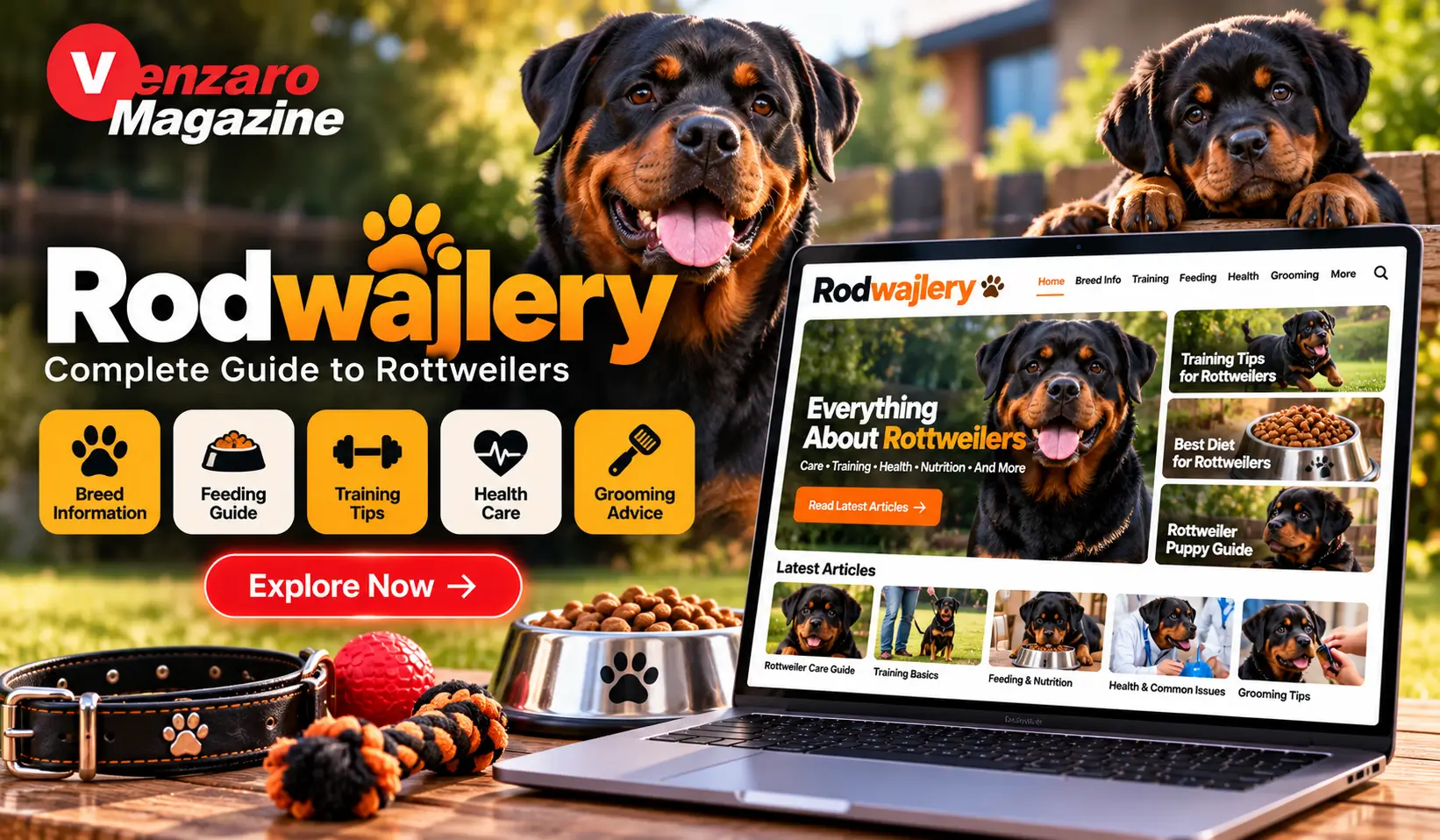
There is another reason this keyword can be confusing. rodwajlery.com currently operates as a website presenting dog walking, pet sitting, overnight care and puppy-care services. The site describes Rodwajlery as a pet-care brand and also contains articles about Rottweilers.
That means a search for “rodwajlery” can produce two overlapping intents: information about the Rottweiler breed and information connected with the Rodwajlery-named website. Readers should look at the URL and page context rather than assuming every result is defining a canine term.
Is Rodwajlery Really the Polish Word for Rottweiler?
This claim appears on several current websites, but it should be presented cautiously. Some blogs state that Rodwajlery is a Polish or Eastern European phonetic form of Rottweiler. However, major breed organizations do not use Rodwajlery as the official breed name, and the strongest current evidence supports Rottweiler as the recognized international name.
It is entirely possible for informal spellings to circulate in speech, search queries or online communities without becoming the standard linguistic form. For SEO purposes, Rodwajlery clearly connects with Rottweiler-related search intent. For formal breed information, Rottweiler remains the reliable term.
Can a First-Time Dog Owner Handle a Rottweiler?
A first-time owner is not automatically incapable of raising a Rottweiler, but this is not a breed to choose casually. The dog’s physical power means training mistakes can become difficult to manage. Someone who is willing to learn, attend training, socialize the puppy properly and create consistent household rules may do well. Someone looking for a dog that requires little structure may find the breed challenging.
Before bringing a puppy home, prospective owners should think realistically about exercise, training costs, veterinary expenses, housing rules, insurance requirements and the time available for daily interaction.
The right question is not simply “Do I like Rottweilers?” It is “Can my lifestyle support this dog for its entire life?”
Can a Rottweiler Live in an Apartment?
Housing size alone does not determine whether a dog receives a good quality of life. A Rottweiler living in an apartment with appropriate exercise, training and routine may have a more satisfying life than one left alone in a large yard with little interaction.
However, practical issues matter. Large dogs take up physical space, shared corridors require good leash manners and some landlords or insurance policies may impose breed restrictions. Owners should verify housing rules before obtaining the dog rather than discovering a problem after the puppy arrives.
A Yard Does Not Replace Exercise
Having a yard is convenient, but opening a door is not the same as providing structured exercise and mental engagement. Many dogs simply stand near the house or patrol the same boundary when left outside.
Walking, training and shared activities provide social and mental stimulation that a yard alone cannot replace.
A Rottweiler was developed to work with people. Treating the dog as a backyard security system misses an important part of the breed’s nature.
Guarding Instinct Should Not Be Encouraged Recklessly
Many people are attracted to Rottweilers because of their protective reputation. A stable adult may naturally alert to unusual activity without being taught to threaten ordinary visitors.
Owners should be cautious about amateur protection training. Teaching biting or defensive behavior without expert supervision can create a dog that becomes difficult to control and may expose the owner and others to serious risk.
For most family homes, reliable obedience, controlled social behavior and secure management are far more valuable than trying to make the dog “more aggressive.”
Rottweiler Puppies Need Boundaries Early
A small puppy jumping onto people can appear harmless. The same habit becomes a problem when the dog reaches adult size. Puppy behavior should therefore be evaluated with the adult dog in mind.
Teach calm greetings, leash manners, handling and household boundaries early. Reward the behaviors you want to see repeated and prevent the puppy from rehearsing habits that will later become difficult to manage.
Training is easier when expectations remain consistent from the beginning.
Do Rottweilers Need Professional Training?
Not every owner needs a full-time professional trainer, but a well-run puppy class or obedience program can be extremely valuable. It gives owners guidance while the dog is still manageable and provides controlled opportunities for learning around distractions.
Choose trainers who explain what they are doing and can adapt to the individual dog. Avoid anyone promising instant dominance or guaranteed behavior through fear-based shortcuts.
A powerful dog benefits from an owner who understands how learning works rather than one who simply tries to overpower it.
Costs of Owning a Rottweiler
The purchase price is only the beginning. Large dogs eat more food than small dogs, require appropriately sized equipment and may generate higher medication or boarding costs because many veterinary products are weight-based. Training classes, preventive veterinary care, emergency treatment, insurance and replacement of large beds or crates can all add to long-term ownership costs.
This is another reason an unusually cheap puppy is not automatically a bargain. Poor breeding or inadequate early care can produce expenses that far exceed the original saving.
A realistic budget should cover the dog’s entire life rather than only the day it comes home.
Local Rules Should Be Checked
Dog ownership laws vary by country, city and housing arrangement. Some locations have specific rules concerning particular breeds, leash requirements, insurance or housing. Because regulations change and differ significantly by jurisdiction, prospective owners should check current local requirements directly with the relevant authority before acquiring a Rottweiler.
Online breed guides should not be used as substitutes for local legal information.
This is especially important when moving internationally or renting a property.
Rodwajlery FAQs
What is Rodwajlery?
Rodwajlery is an informal online term commonly associated with the Rottweiler dog. It is not listed as a separate recognized breed by the FCI or AKC.
Is Rodwajlery the same as a Rottweiler?
For practical breed research, current search usage points toward the Rottweiler. The officially recognized breed name is Rottweiler, not Rodwajlery.
Is Rodwajlery a separate dog breed?
No major breed registry reviewed for this article identifies Rodwajlery as a separate breed. The FCI recognizes the Rottweiler under Standard No. 147.
Where do Rottweilers come from?
The recognized breed originates from Germany and is strongly associated historically with the town of Rottweil. FCI records Germany as the country of origin.
Are Rottweilers good family dogs?
Individual temperament and upbringing matter, but properly trained and socialized Rottweilers can be affectionate and devoted family companions. Their size means interactions with small children should be supervised.
Are Rottweilers aggressive?
The official FCI standard describes the desired temperament as good-natured, devoted, self-assured, alert and even-tempered rather than indiscriminately aggressive. Training, genetics and socialization strongly influence individual behavior.
How big does a Rottweiler get?
AKC information places adult females around 22–25 inches and males around 24–27 inches at the shoulder, with a broad typical weight range of about 80–135 pounds.
Do Rottweilers need a lot of training?
Early and consistent training is particularly important because Rottweilers are intelligent, strong and naturally watchful dogs. AKC specifically emphasizes early socialization and training.
What health tests should a Rottweiler breeder perform?
The American Rottweiler Club’s current mandatory practices include hip, elbow, eye and cardiac evaluation along with JLPP-related testing and CHIC requirements for breeding stock.
Is Rodwajlery the official Polish name for Rottweiler?
The available authoritative breed evidence does not establish Rodwajlery as the official breed name. Several blogs describe it as a regional or phonetic form, but major international breed records use Rottweiler.
Is Rodwajlery also a website?
Yes. Rodwajlery.com currently presents pet-care services including dog walking, pet sitting, overnight care and puppy care, and it also publishes Rottweiler-related content.
Final Thoughts
Rodwajlery looks like the name of a separate breed when it first appears in a search result, but authoritative canine records point back to the familiar Rottweiler. FCI recognizes the Rottweiler as a German breed under Standard No. 147, while AKC places it among established working breeds. There is no equivalent recognized Rodwajlery breed record in those sources.
That difference is useful because accurate terminology leads to better information. Someone considering one of these dogs needs reliable guidance about temperament, training, health screening, exercise and responsible breeding rather than a new label created around an unusual spelling.
The Rottweiler is already a distinctive breed without needing an invented identity. Its power requires responsible handling, its intelligence rewards thoughtful training and its health deserves careful breeder selection. People who can provide structure, socialization, companionship and consistent care may find an exceptionally devoted working companion behind the intimidating appearance.
More News: AdsTotally.com Review 2026: What the Website Really Offers