






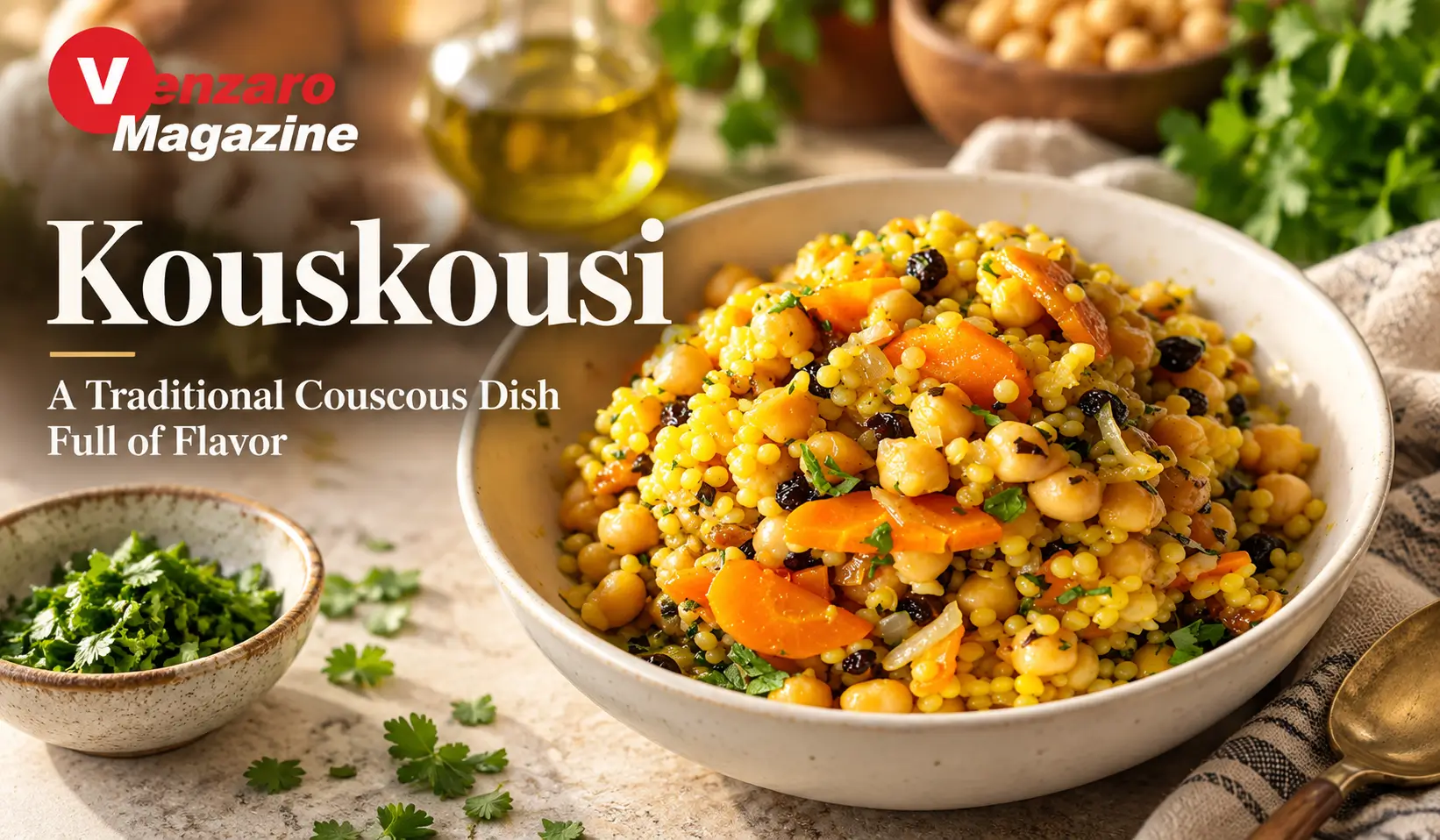


Tiny pasta has a way of making simple food feel comforting. It disappears easily into broth, works with beans and vegetables, and cooks quickly enough for an ordinary weekday meal. Kouskousi fits neatly into that category, but the name creates more confusion than the food itself. Some online articles describe it as another spelling of North African couscous, while others use it for a small Greek pasta. The second meaning is not imaginary: Greek food writer and chef Diane Kochilas uses the term “Greek kouskousi pasta” in recipes with chickpeas, greens and lentils. At the same time, traditional couscous has its own separate North African culinary history and preparation method, formally recognized by UNESCO through the shared heritage of Algeria, Mauritania, Morocco and Tunisia.
What Is Kouskousi?
Kouskousi can refer to a very small pasta used in Greek cooking. Its size makes it useful in soups, vegetable dishes, bean recipes and pilaf-style meals. Diane Kochilas, one of the clearest culinary sources using the name, describes “Greek kouskousi” as a tiny pasta and cooks it separately before combining it with ingredients such as chickpeas and Swiss chard. In another recipe, she pairs a similar tiny kouskousi pasta with lentils and dried fruit.
The name creates confusion because it resembles “couscous” very closely. That resemblance has led many recent articles to assume the two names automatically describe the same food. In practice, the safest approach is to look at the culinary context. If a recipe calls for Greek kouskousi and instructs you to boil and drain it like pasta, you are dealing with a small pasta product. If the recipe is discussing traditional North African couscous, the food and preparation tradition are different.
Is Kouskousi the Same as Couscous?
Not necessarily. This is the most important distinction to understand.
Traditional couscous is made from semolina that is moistened, formed into small granules and traditionally steamed. UNESCO’s documentation of couscous specifically describes semolina being rolled by hand and steamed as part of the inherited production process shared by communities in Algeria, Mauritania, Morocco and Tunisia.
Greek kouskousi, on the other hand, can function as a true pasta. Kochilas instructs cooks to place the pasta in boiling salted water, cook it according to package directions and drain it before combining it with the rest of the dish. That is a standard pasta method rather than traditional couscous steaming.
The two foods can look similar because both are small and wheat-based, but appearance alone does not make them interchangeable.
Why Online Articles Disagree About Kouskousi
The current search results are unusually inconsistent. One group of pages calls Kouskousi a North African couscous spelling, another describes it as Greek pasta, and some try to merge both definitions. That confusion probably comes from the sound and appearance of the word. Couscous itself has many transliterations across languages, while Greece also has tiny pasta traditions whose names can sound similar.
This is exactly why it is better to rely on actual culinary usage instead of building a history from spelling alone. A real Greek cooking source uses the term kouskousi for pasta, while UNESCO provides strong documentation for the separate North African couscous tradition.
If you have a packet labeled Kouskousi in front of you, the ingredient list and cooking instructions are more useful than a generic internet definition.
What Does Greek Kouskousi Look Like?
Greek kouskousi is typically very small, making it closer in appearance to tiny pasta shapes such as pastina or very small orzo than to large noodles. Depending on the producer, the shape may appear as tiny beads or short miniature pieces.
Its small size is one of its advantages. It absorbs flavor quickly and distributes evenly through a dish, which makes it well suited to recipes containing lentils, chickpeas, vegetables and broth.
Because commercial products can vary, there is no reason to assume every package labeled kouskousi will have exactly the same diameter, cooking time or ingredients. Follow the package rather than forcing every product into one fixed description.
What Is Kouskousi Made From?
The exact ingredients depend on the manufacturer or household recipe. Tiny Greek pasta products may be made from durum wheat or semolina, while some regional pasta traditions can include other wheat flours, eggs or dairy.
This is another reason the package label matters.
If you are buying kouskousi because of an allergy, vegan diet or other dietary requirement, do not assume that one brand’s ingredient list applies to every version. Check for wheat, egg and milk individually.
Traditional North African couscous is also closely associated with semolina, but its production process and culinary identity are separate. UNESCO describes the traditional process beginning with cereal that is ground into semolina and then rolled and steamed.
Is Kouskousi a Grain?
Greek kouskousi pasta should be treated as pasta rather than a whole grain such as rice, barley or quinoa. Its very small shape can make it look grain-like after cooking, but shape does not determine the food category.
The same visual confusion happens with orzo. Orzo looks like large grains of rice, yet it is pasta.
Couscous also causes similar confusion because its individual granules look grain-like even though they are produced from semolina.
For cooking purposes, what matters is not what the food resembles but how that specific product was made and how the producer tells you to cook it.
How to Cook Greek Kouskousi
For a commercially packaged Greek kouskousi pasta, start with the manufacturer’s instructions. Diane Kochilas’ recipe provides a useful general example: bring salted water to a boil, add the kouskousi, cook it according to the package directions, then drain it. She combines the cooked pasta with sautéed vegetables, Swiss chard and chickpeas before warming everything together briefly.
That method is simple and adaptable. You can cook the pasta separately when you want precise control over texture, especially if the final dish already contains a thick sauce or cooked vegetables.
Avoid guessing the cooking time. Tiny pasta can move from pleasantly firm to excessively soft quickly because the pieces are so small.
Can You Cook Kouskousi Directly in Soup?
Small pasta often works well when cooked directly in soup, provided there is enough liquid. The main thing to remember is that the pasta will absorb broth while it cooks and may continue absorbing liquid after the pot is removed from the heat.
That can turn a light soup into a thick one after it sits.
If you expect leftovers, you may prefer to cook the kouskousi separately and add it to individual bowls. This prevents the pasta from absorbing most of the broth overnight.
If you like a thicker, almost stew-like consistency, cooking it directly in the pot can work very well.
Kouskousi With Chickpeas and Greens
One of the clearest documented uses for Greek kouskousi is with chickpeas and leafy greens. Kochilas prepares onions, garlic, leek and ginger, adds Swiss chard and chickpeas, then combines the mixture with separately cooked kouskousi.
This type of dish works because each ingredient contributes something different. The pasta adds soft texture and carbohydrates, chickpeas provide body and protein, while greens keep the dish from becoming too heavy.
You can use the same general structure with spinach, kale or another leafy vegetable, adjusting cooking time according to the green.
The result does not need a heavy sauce because the vegetables, olive oil and seasoning can carry the dish.
Kouskousi With Lentils
Lentils are another natural match. Diane Kochilas uses tiny Greek kouskousi in a lentil dish flavored with cumin, coriander and dried fruit.
This pairing is useful because lentils and small pasta create different textures while remaining easy to eat in the same spoonful. Spices and dried fruit can push the dish toward a sweet-savory direction, while lemon, herbs and olive oil can keep it fresher.
You do not have to copy one exact combination. The broader idea is that kouskousi works particularly well with legumes because its small shape distributes evenly through them.
Kouskousi in Vegetable Dishes
Vegetables with some moisture work especially well with tiny pasta. Tomato, zucchini, peppers, mushrooms, spinach, chard and eggplant can all create enough flavor that the pasta does not need much additional sauce.
Cook watery vegetables before combining them with the pasta so that excess moisture can reduce. Otherwise, the finished dish may feel thin.
Roasted vegetables also work. Their concentrated flavor pairs well with the mild pasta and creates a meal that can be served warm or closer to room temperature.
A little olive oil, herbs and acidity from lemon or vinegar can be enough to finish the dish.
Can Kouskousi Be Used in Salad?
Yes, provided the pasta is not overcooked. Small pasta can work well in cold or room-temperature salads because it mixes evenly with chopped vegetables, herbs and legumes.
After cooking, drain it well and allow it to cool. A light coating of olive oil can help prevent sticking.
Add ingredients such as cucumber, tomato, parsley, mint, chickpeas, roasted vegetables or feta depending on the style you want.
Do not overwhelm tiny pasta with a very heavy dressing. Since each piece has a large surface area relative to its size, it can carry plenty of flavor without needing excessive sauce.
Kouskousi With Meat or Chicken
The mild flavor makes kouskousi useful next to strongly seasoned meats. Chicken cooked with lemon, garlic and herbs can be served over it, or shredded meat can be folded directly through the pasta.
If the meat produces a flavorful cooking liquid, use some of that liquid to season the pasta rather than adding a separate sauce.
Small pasta is particularly useful when you want the starch to absorb the flavor of the rest of the meal instead of competing with it.
Portion size matters because tiny pasta can look deceptively small before cooking. Measure it rather than estimating from the dry volume in a large bowl.
Kouskousi With Seafood
A simple seafood preparation works well because tiny pasta does not overpower delicate ingredients. Shrimp, mussels or pieces of fish can be combined with tomato, garlic, herbs and cooked kouskousi.
Seafood should generally be cooked separately or added at the appropriate point so it does not become tough while the pasta finishes cooking.
A light tomato broth or lemon-and-olive-oil dressing can connect the components without masking them.
Again, this is an area where small pasta is more flexible than a large noodle because every spoonful can contain a little seafood, vegetable and pasta together.
Kouskousi vs Traditional Couscous
The biggest difference is preparation and culinary tradition. Greek kouskousi can be a small boiled pasta, while traditional North African couscous involves semolina granules that are traditionally rolled and steamed. UNESCO’s heritage documentation specifically describes rolling the semolina by hand and steaming it as central parts of couscous preparation.
Traditional couscous is also deeply connected with social practices, family knowledge, shared meals and regional traditions across North Africa. UNESCO notes its association with solidarity, conviviality, sharing and togetherness.
Calling every small wheat product “the same as couscous” removes these important differences.
Kouskousi vs Pearl Couscous
Pearl couscous is larger than traditional couscous and is commonly cooked more like pasta. It is often sold as Israeli couscous or pearl couscous in English-language supermarkets.
Greek kouskousi may be much smaller, depending on the producer.
The two can sometimes substitute for one another in informal recipes, but they will not cook at the same speed or produce exactly the same texture.
If substituting, adjust both the cooking time and amount of liquid instead of replacing one with the other blindly.
Kouskousi vs Orzo
Orzo is larger and shaped like grains of rice. Kouskousi is generally smaller and can disappear more easily into soups and legume dishes.
Both are useful in broths, salads and one-pot meals, so substitution is possible when exact shape is not critical.
However, larger orzo takes longer to cook and provides a more noticeable bite.
Kouskousi is better when you want the pasta to blend into the dish, while orzo works well when you want each pasta piece to remain more distinct.
Kouskousi vs Pastina
Pastina is a broad Italian term for very small pasta shapes rather than one single shape. In terms of culinary use, kouskousi can occupy similar territory.
Both can be added to soups, cooked for simple comfort meals or paired with vegetables and cheese.
The main difference lies in culinary tradition and the specific product. A star-shaped Italian pastina is not the same product as Greek kouskousi even though both are small.
Thinking of them as relatives in function rather than identical foods is more accurate.
Is Kouskousi Gluten-Free?
Traditional wheat-based kouskousi is not gluten-free. If the product is made from semolina, durum wheat or ordinary wheat flour, it contains gluten.
People with celiac disease or medically required gluten avoidance should not rely on the product name alone. Check the ingredient list and allergen statement carefully.
Gluten-free small pasta alternatives made from rice, corn or legumes exist, but they should only be called gluten-free when the packaging confirms it.
Traditional couscous made from wheat semolina also contains gluten.
Is Kouskousi Vegan?
It depends on the recipe and product. A simple dry pasta made from wheat and water can be vegan, but some traditional or commercial tiny pasta products may contain egg or dairy ingredients.
Check the packaging.
The dish itself can easily be prepared vegan with beans, lentils, vegetables, olive oil and herbs.
Diane Kochilas’ chickpea-and-greens recipe using Greek kouskousi is presented as vegan and vegetarian, demonstrating how naturally the pasta can fit into plant-based meals.
Is Kouskousi Healthy?
There is no useful way to label one pasta shape simply healthy or unhealthy without considering portion size and the rest of the meal. Wheat-based kouskousi mainly provides carbohydrate, with nutrition varying according to the flour and recipe.
The overall meal matters more.
A bowl containing kouskousi, chickpeas, greens and olive oil has a different nutritional profile from the same pasta covered in a large amount of butter and cheese.
People who need precise nutritional information should check the package because recipes and brands can differ.
How Much Kouskousi Should You Cook?
Tiny dry pasta expands during cooking, and its size makes it easy to pour too much into the pot. Follow package serving suggestions where available.
For soups, use less than you would for a standalone pasta dish because it continues absorbing liquid.
For salads or main dishes, cook enough to support the other ingredients rather than making the vegetables and legumes feel like small additions to a bowl of starch.
If trying it for the first time, making a slightly smaller batch is easier than trying to rescue a pot that has become almost entirely pasta.
Why Kouskousi Can Turn Mushy
Overcooking is the main reason. Small pasta cooks quickly because water reaches the center of each piece faster than it would in a larger shape.
Start checking texture early.
If you plan to combine the pasta with hot vegetables or simmer it briefly in sauce afterward, stop the initial cooking slightly earlier so it can finish in the second stage.
Leaving cooked kouskousi sitting in hot water after the heat is turned off will also continue softening it.
Drain promptly once the desired texture is reached.
Why Kouskousi Sticks Together
Small pasta pieces have plenty of surface starch and can stick as they cool. Use enough cooking water, stir during the first part of cooking and drain properly.
If the pasta will sit before being combined with the rest of the dish, a small amount of olive oil can help keep the pieces separate.
Do not rinse automatically unless the recipe calls for it. Rinsing removes surface starch, which can be useful in some cold applications but may reduce the way sauce clings in a warm dish.
Match the technique to the final recipe.
How to Store Cooked Kouskousi
Allow cooked pasta to cool before placing it in a covered container in the refrigerator. Storage time depends on the complete dish and ingredients, so follow ordinary food-safety practices rather than relying on the pasta alone.
If the kouskousi has been mixed into soup, expect it to absorb more liquid during storage.
Keeping pasta and broth separate can preserve texture better for leftovers.
When reheating, a small amount of water, broth or sauce may help restore moisture.
Can You Freeze Kouskousi?
Cooked small pasta can technically be frozen, but texture may soften after thawing. It is usually better in dishes where a slight texture change does not matter, such as soups and stews.
For the best result, slightly undercook the pasta before freezing it as part of a meal.
Plain dry kouskousi stores well in the pantry when kept sealed, dry and within the manufacturer’s recommended shelf life, so there is rarely a need to cook large amounts solely for freezing.
Buying Kouskousi
The best clue is the package itself. Look at the country of origin, ingredients, product description and cooking method.
If the package describes the product as pasta and instructs you to boil and drain it, treat it as pasta.
If you are looking for traditional North African couscous, buy a product specifically labeled couscous and follow the preparation method appropriate to that product.
Do not rely only on the visual appearance of the contents because many small wheat products look very similar through a package.
Why Traditional Couscous Deserves Separate Recognition
The online confusion around Kouskousi makes it especially important not to flatten traditional couscous into a generic “tiny pasta” category. In 2020, UNESCO inscribed the knowledge, know-how and practices surrounding couscous on its Representative List of the Intangible Cultural Heritage of Humanity after a joint nomination from Algeria, Mauritania, Morocco and Tunisia.
The recognition covers much more than an ingredient. It includes preparation methods, tools, social practices and knowledge passed between generations. UNESCO specifically describes couscous as connected with sharing, solidarity and conviviality.
That cultural context is worth preserving instead of casually treating every similarly named pasta as identical.
Is Kouskousi a Greek Food?
There is credible evidence for Greek culinary use of the term. Diane Kochilas explicitly uses “Greek kouskousi pasta” in published recipes.
That does not mean every use of a similar-sounding word around the Mediterranean refers to exactly the same product, nor does it mean Greek kouskousi replaces the separate history of couscous.
The most accurate answer is contextual: Kouskousi can refer to a small Greek pasta in actual Greek culinary usage, while similarly spelled online references sometimes confuse it with couscous.
Why the Search Results Became So Confusing
The keyword has attracted a large number of articles in 2026, and many of them repeat claims from one another. Some call Kouskousi a purely North African dish, some call it exclusively Greek, and some combine the two stories without distinguishing the products.
The problem is not that similar food names cannot exist in different regions. They clearly can.
The problem is presenting one interpretation as settled without checking how cooks actually use the word.
Using authoritative cultural documentation for couscous and real Greek recipe sources for kouskousi creates a much clearer picture than repeating generic descriptions from competing blogs.
A Simple Kouskousi Meal Idea
Cook the kouskousi according to its package instructions and drain it while it is still pleasantly firm. In a separate pan, soften onion and garlic in olive oil, then add chickpeas and a leafy green such as spinach or Swiss chard. Season with black pepper, lemon and herbs, then fold in the cooked pasta and warm everything together briefly.
This is not presented as one fixed traditional recipe. It is a practical meal structure inspired by the documented use of Greek kouskousi with chickpeas and greens.
The combination is easy to modify with seasonal vegetables or herbs already available in the kitchen.
Common Mistakes When Cooking Kouskousi
The first mistake is assuming every product with a couscous-like name should be prepared the same way. Read the instructions before adding water.
The second is overcooking. Tiny pasta needs attention because a few additional minutes can noticeably change texture.
The third is using too much in soup. Small pasta absorbs more liquid than it appears capable of absorbing when dry.
The fourth is ignoring ingredients. People with dietary restrictions should check for wheat, eggs and dairy rather than making assumptions from the product shape.
The fifth is confusing Greek pasta with traditional couscous and then using the wrong cooking method.
Kouskousi FAQs
What is Kouskousi?
Kouskousi is used in Greek cooking for a very small pasta. Greek chef Diane Kochilas explicitly refers to “Greek kouskousi pasta” in published recipes.
Is Kouskousi the same as couscous?
Not automatically. Greek kouskousi can be boiled as pasta, while traditional North African couscous is made from semolina granules and traditionally steamed.
Is Kouskousi Greek?
There is documented Greek culinary use of the name for tiny pasta, including recipes from Diane Kochilas.
Is couscous North African?
Yes. UNESCO’s couscous heritage inscription was jointly nominated by Algeria, Mauritania, Morocco and Tunisia and documents the production and consumption traditions associated with couscous in those communities.
How do you cook Kouskousi?
For Greek kouskousi pasta, follow the packet directions. One documented recipe cooks it in boiling salted water and drains it before combining it with vegetables and chickpeas.
Is Kouskousi pasta?
In documented Greek culinary usage, yes, it can refer to tiny pasta.
Does Kouskousi contain gluten?
Wheat- or semolina-based kouskousi contains gluten. Check individual packaging because ingredients can vary.
Can you put Kouskousi in soup?
Yes. Small pasta works well in soup, although it can continue absorbing broth while the dish sits.
Can Kouskousi be used with lentils?
Yes. A published Diane Kochilas recipe pairs tiny Greek kouskousi with lentils, spices and dried fruit.
Is Kouskousi vegan?
Some products may be vegan, while others could contain egg or dairy. Check the ingredient list. Vegan recipes using Greek kouskousi also exist.
Final Thoughts
Kouskousi becomes much easier to understand when similar-looking foods are not forced into one category. There is genuine Greek culinary usage of kouskousi as a tiny pasta, including published recipes where it is boiled, drained and combined with legumes and vegetables.
Traditional couscous deserves its own explanation. Its semolina granules, steaming process and social traditions are strongly documented, and UNESCO recognizes the knowledge and practices associated with couscous in Algeria, Mauritania, Morocco and Tunisia as intangible cultural heritage.
So when a recipe or package says Kouskousi, do not guess from the name alone. Check where the product comes from, what the ingredients are and how the manufacturer tells you to cook it. If it is Greek kouskousi pasta, treat it like the tiny pasta it is. If you are preparing traditional couscous, respect the separate method and culinary tradition behind that dish.
One similar-sounding name can describe foods that look related on the plate but belong to different cooking stories.
More Trending Stories: Your Venzaro Magazine