








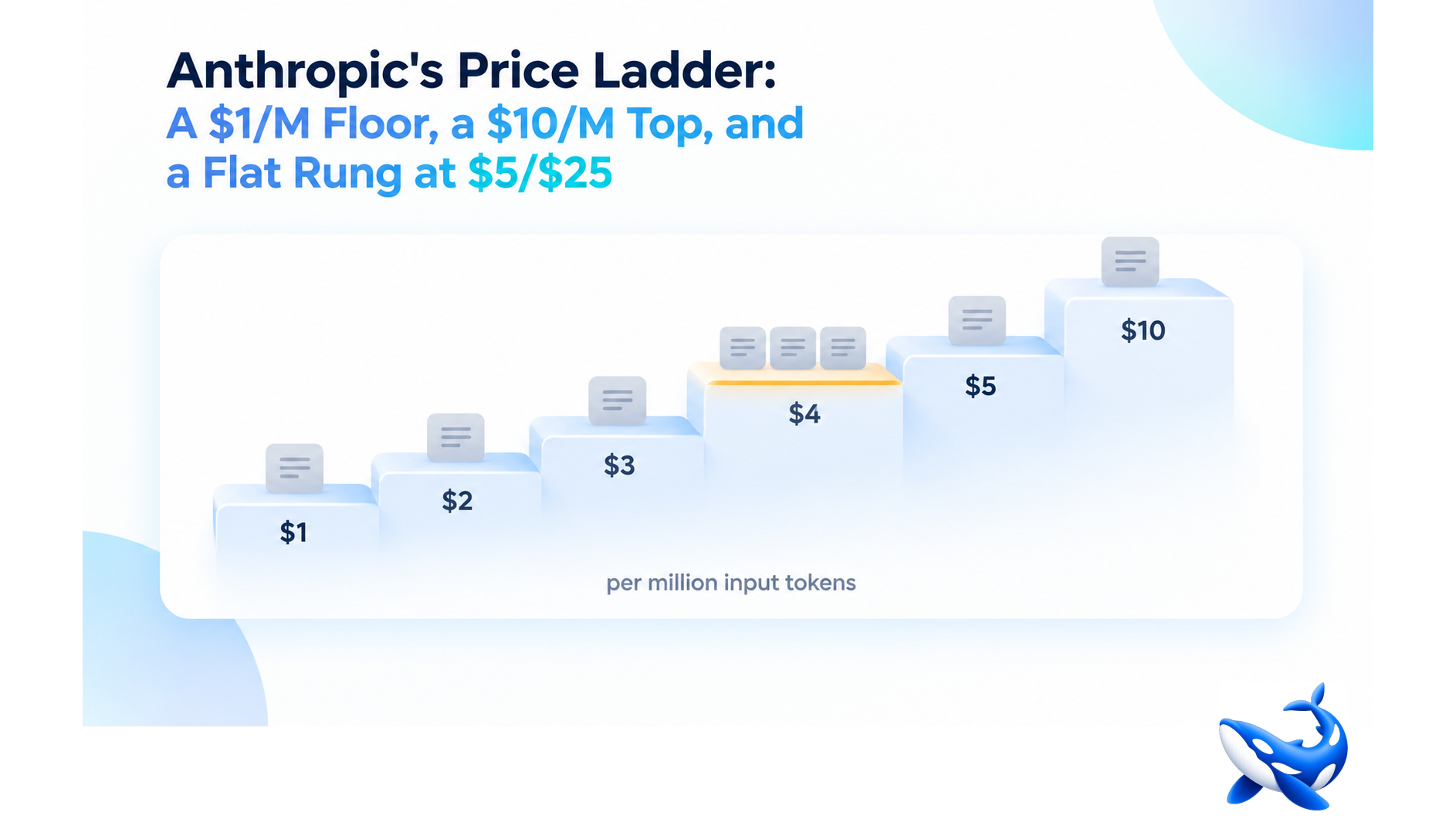
A price ladder is arithmetic, so start with the arithmetic: on the OrcaRouter anthropic models page, the cheapest input price is $1.00 per million tokens and the dearest is $10.00 — a ten-fold span across thirteen models. Divide the two and you have the whole shape of the catalogue: one floor, one top, and four rungs between them.
Then look at what stands on the rungs, because the interesting thing about this ladder is not its height. Three models — Claude Opus 4.7, Claude Opus 4.8 and Claude Opus 5 — sit at the identical $5.00 / $25.00 and carry the identical quality score, and two of them are the rows a reader would ordinarily treat as consecutive generations. A flat rung in a price ladder is a statement about versioning, and it is worth reading carefully before you pick a step.
Six rungs across thirteen rows
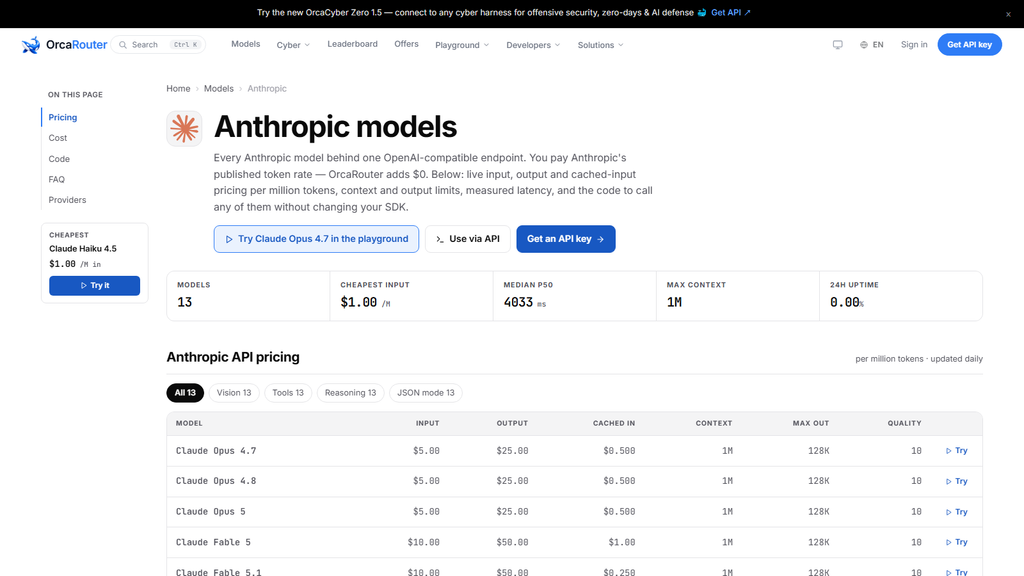
Here is the catalogue sorted by input price.
| Model | Input /M | Output /M | Context | Quality |
| Claude Haiku 4.5 | $1.00 | $5.00 | 200K / 64K out | 5 |
| Claude Sonnet 5 | $2.00 | $10.00 | 1M | 9 |
| Claude Sonnet 5.5 | $2.00 | $10.00 | 1M | 9 |
| Claude Sonnet 4.6 | $3.00 | $15.00 | 1M / 64K out | 8 |
| Claude Sonnet 4.5 | $3.00 | $15.00 | 1M / 64K out | 6 |
| Claude Opus 5.5 | $4.00 | $20.00 | 1M | 9 |
| Claude Opus 4.7 | $5.00 | $25.00 | 1M | 10 |
| Claude Opus 4.8 | $5.00 | $25.00 | 1M | 10 |
| Claude Opus 5 | $5.00 | $25.00 | 1M | 10 |
| Claude Opus 4.6 | $5.00 | $25.00 | 1M | 9 |
| Claude Opus 4.5 | $5.00 | $25.00 | 200K / 64K out | 8 |
| Claude Fable 5 | $10.00 | $50.00 | 1M | 10 |
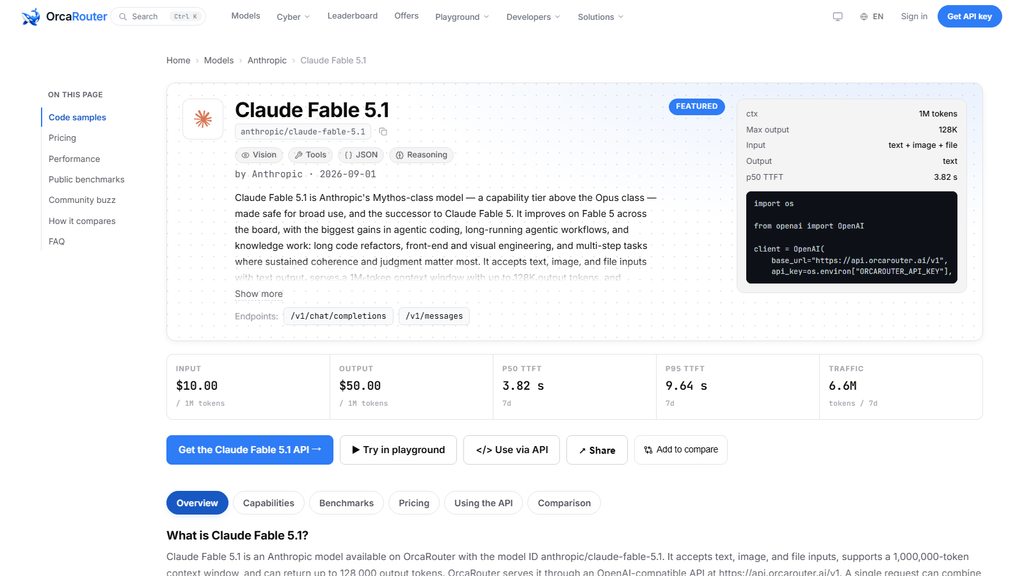
| Claude Fable 5.1 | $10.00 | $50.00 | 1M | 10 |
Thirteen models, six distinct input prices: $1, $2, $3, $4, $5, $10. Nothing in between, no row landing at $6.50 or $7.20, and no model priced to fill the wide gap between the $5 rung and the $10 top. The catalogue is built from price points rather than from a continuum.
The first arithmetic worth noticing is the multiplier. Read the output column against the input column down all thirteen rows and the ratio is exactly 5.0 in every single one: $1 buys $5 out, $2 buys $10, $3 buys $15, $4 buys $20, $5 buys $25, $10 buys $50. That uniformity is unusual and it makes the ladder easy to hold in your head — whatever a row costs to read, it costs five times as much to write, so a workload that is heavy on generation and a workload that is heavy on reading scale across the ladder in the same proportion. The price you pay for being on a higher rung is a fixed multiple, not a changing one.
The flat rung at $5/$25
Now count what stands on the $5 rung. Five models: Opus 4.5, Opus 4.6, Opus 4.7, Opus 4.8 and Opus 5. Three of them — 4.7, 4.8 and 5 — are indistinguishable on the two columns a buyer scans first, carrying the same input price, the same output price, and the same quality digit.
That quality digit is our own 0-to-10 composite, built from our own quality dimensions across the catalogue — it is our measurement, not a third-party benchmark — and it is deliberately coarse. It tells you which tier a model belongs in without pretending to rank two models that land on the same number. So read the flat rung for what it is: three consecutive-looking generations that our own composite does not separate, priced identically, from one vendor, on one page.
A price ladder with a flat rung is telling you how the vendor versions its product. When a new generation arrives at the same price point as the one it replaces, and the price point holds across three generations, the price is not tracking the model. Something else is: a tier. The vendor has decided that a certain level of capability costs $5 per million input tokens, and the models on that rung are the successive attempts to deliver that tier. Under that reading, the version number moves and the price does not, and a reader choosing between Opus 4.7 and Opus 5 is not choosing between a cheap option and an expensive one — they are choosing between two deliveries of the same tier at the same rate.
The same pattern repeats up the ladder. Fable 5 and Fable 5.1 sit together at $10.00 / $50.00, both on our composite a 10. Sonnet 5 and Sonnet 5.5 sit together at $2.00 / $10.00, both a 9 on our composite. Three rungs, and on each one the newest generation is priced exactly where its predecessor was.
Where the flat rung stops being flat
Two rungs break the pattern, and both breaks are informative.
The $3 rung holds Claude Sonnet 4.6 and Claude Sonnet 4.5 at the same $3.00 / $15.00 — and those two are not the same tier on our composite: 4.6 reads an 8 and 4.5 reads a 6. Same price, two points apart. That is the opposite arrangement from the flat rungs above: here the price point held still while the composite moved, which is the ordinary shape of a generation update that improves a model without changing what it costs to run.
The $5 rung shows the same thing one level higher. Opus 4.5 reads an 8 on our composite, Opus 4.6 a 9, and Opus 4.7, 4.8 and 5 a 10 — five models at one price spanning three points of a ten-point composite. So the flat rung is not a shelf where the vendor stopped improving. It is one where the improvements happened at a fixed price, and the composite is the column that records them.
That is the useful way to read a flat rung: the price column tells you the tier, and the quality column is where versioning shows up. If your reading of a catalogue only looks at price, fifty percent more iterations of a model at the same rate looks like nothing happened at all.
Two ceilings on a ten-fold ladder
Price is not the only column that spans. Context does too, and less evenly: eleven of the thirteen rows carry a 1M window, while Claude Opus 4.5 and Claude Haiku 4.5 each stop at 200K with a 64K output cap. So the catalogue’s cheapest row and one of its mid-priced rows share the smallest window, and the rungs above them do not.
| Rung | Cheapest model | Input /M | Context | Quality |
| $1 | Claude Haiku 4.5 | $1.00 | 200K | 5 |
| $2 | Claude Sonnet 5 / 5.5 | $2.00 | 1M | 9 |
| $3 | Claude Sonnet 4.6 | $3.00 | 1M | 8 |
| $4 | Claude Opus 5.5 | $4.00 | 1M | 9 |
| $5 | Claude Opus 4.7 / 4.8 / 5 | $5.00 | 1M | 10 |
| $10 | Claude Fable 5 / 5.1 | $10.00 | 1M | 10 |
Two things follow. The first is that the two cheapest useful entry points into this catalogue for short-context work are not adjacent rungs — Haiku 4.5 at $1 and Sonnet 5 at $2 are one dollar apart and ten times apart in window, which makes the $2 rung the cheapest row on the page that can hold a repository-sized prompt. The second is that the ladder’s top and its middle deliver the same window to you: at $5 and at $10 the context column reads 1M either way, so the extra $5.00 per million input buys capability rather than room.
Capability is not a differentiator anywhere on this ladder, which is worth stating plainly. All thirteen models support vision, tool calling, reasoning and JSON mode — the page’s capability census reads 13 in each of the four categories, covering the floor and the top alike. Every rung is a general-purpose rung; what separates them is price, window and quality, in that order of visibility.
One convention to fix before quoting any of this. The page’s FAQ gives the largest context window as 1000K tokens, naming Claude Opus 4.7; the pricing table’s own context column writes 1M for the same model. Those are two spellings of one window on one page, and this article quotes the table because the table is where a reader scanning the catalogue reads the number.
The takeaway
A ten-fold input ladder with six rungs and a uniform 5.0 output multiplier is a catalogue you can read as a table rather than as a brochure. The floor is $1.00 and the top is $10.00; twelve of the thirteen rows carry a 1M window, and every row is fully capable, so the decision is made among price, window and tier and nothing else. That is a narrow decision, and narrow decisions are the ones worth making deliberately.
The flat rung is the part that repays attention. Three generations of Opus standing on $5.00 / $25.00 with the same quality digit on our composite is not three identical models and it is not three different prices — it is one price point and three successive deliveries of the tier that price buys. Pick the newest, unless the older one is the one you have already validated. Where the rung stops being flat — Sonnet 4.5 and 4.6 at $3.00 with different composite digits, five Opus rows at $5.00 spanning three points — the composite is the column that records the versioning, and the price column is the one that shows you nothing moved.
The arithmetic, in the end, is only two numbers wide: a floor and a top, with a fixed multiple between reading and writing. Everything else on this ladder answers a question about versioning, not about cost.
Sourcing note: the thirteen models, their input and output rates, context windows and the capability census are from the OrcaRouter Anthropic provider page, read 2026-10-14 [OURS]. The rates themselves — Claude Opus 4.7 at $5.00/$25.00 per million tokens and the cheapest row, Claude Haiku 4.5, at $1.00/$5.00 — are the vendor’s published rate card, passed through with $0 markup [VENDOR]. The 0-to-10 quality scores are our own composite, built from our own quality dimensions across the catalogue, and are not a third-party benchmark. The 1000K figure in the FAQ paragraph is the vendor page’s own rounding of the same window the table writes as 1M; this article quotes the table. No [INDEPENDENT] third-party figures are used. All figures checked 2026-10-14.