




Sodiceram is a name associated with ceramics, but its meaning is less straightforward than some online descriptions suggest. Recent articles present it as a new type of sodium-enhanced ceramic material designed for strong, durable surfaces. Meanwhile, French company records identify a business operating under the closely matching name SO DI CERAM in the building and decorative products sector.
These references are not necessarily describing the same thing.
For homeowners researching tiles, designers comparing surface materials and readers encountering an unfamiliar term, that distinction matters. A convincing product description does not establish that a particular material has been manufactured, independently tested or certified for its proposed use.
Sodiceram is best understood as a name with a documented business connection and a separate set of largely unverified claims about advanced ceramic technology.
Understanding both sides makes it easier to distinguish established information from marketing language and evaluate whether a product described as Sodiceram is suitable for a real project.
What Is Sodiceram?
The name Sodiceram appears in two notably different contexts.
The first is a documented French business. Public company records identify SO DI CERAM, also written SODICERAM, as a limited liability company based in Reims, France. Its registered activity involved wholesale sanitary equipment and decorative products, while historical business descriptions also mention tiles and related building materials.
The second meaning appears in recent online discussions of ceramics and material science. In those articles, Sodiceram is described as a modern ceramic material supposedly improved through sodium-containing compounds.
This interpretation is technically plausible in one respect: sodium-bearing ingredients have established uses in ceramic production. However, the general science of ceramic manufacturing does not verify the existence or performance of a specific product called Sodiceram.
The name alone therefore cannot tell a buyer exactly what a product contains or how it will perform.
Is Sodiceram a Brand or a Material?
There is reliable historical evidence of a business using the name, but insufficient independent evidence to treat Sodiceram as a universally recognised technical category.
This distinction is important because brands and materials are identified in different ways.
A business can be verified through company registration information, historical records and commercial documentation. A material requires additional evidence, including its composition, production method and measurable performance characteristics.
A product carrying the Sodiceram name would need to be assessed on its own specifications, rather than through assumptions about either the historic company or recent online descriptions.
The French Company Behind the Sodiceram Name
SO DI CERAM was a French limited liability company registered in Reims, in the Marne department.
Public records identify it under SIREN number 315 383 091, a French business identification number. The company was associated with wholesale sanitary equipment and decorative products, with historical records also referring to the sale and installation of tiling and bathroom-related materials.
Its recorded history dates back to 1979.
The company ceased its activities in September 2021. Judicial liquidation proceedings opened in November of that year, and its removal from the French commercial register was recorded on 11 October 2023.
These records establish that the name had a genuine commercial history within a sector closely connected to ceramics and interior finishing products.
However, they do not demonstrate that the company developed a sodium-enhanced advanced ceramic material. Nor do they establish a connection between the former business and every recent website using the same term.
That limitation is worth remembering when an online article describes Sodiceram as an active manufacturer or a newly established global brand.
Why Is Sodiceram Described as a Sodium-Based Ceramic?
Several online descriptions interpret the name as a combination of references to sodium and ceramics.
They portray Sodiceram as a material whose properties are improved by incorporating sodium-containing compounds during manufacturing.
The explanation draws on a genuine area of ceramic science, but it needs context.
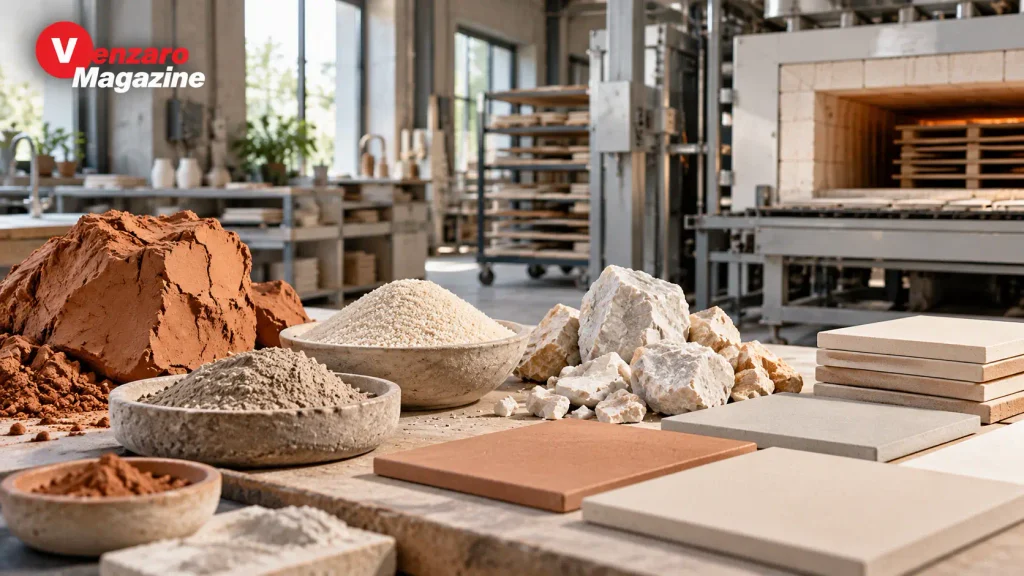
Ceramics are produced using different combinations of inorganic raw materials, including clays, silica and other minerals. Their final characteristics depend on composition, shaping, heating conditions and the internal structure formed during firing.
Certain sodium-bearing ingredients can influence this process, particularly through their role as fluxes.
How Sodium Compounds Work in Ceramics
A flux is an ingredient that helps promote melting or the formation of a liquid phase during heating.
In some ceramic formulations, sodium-containing feldspars contribute to this process. The liquid phase can help particles consolidate as the material is fired.
This is connected to vitrification, the development of a glass-like phase within a ceramic body.
The process can influence porosity, density and other material properties.
However, adding sodium does not automatically make a ceramic stronger, safer or more resistant to every form of damage. The results depend on the complete formulation and manufacturing conditions.
There is also no universal rule that a sodium-containing ceramic must outperform conventional porcelain.
Does Sodiceram Have a Verified Composition?
A consistent, independently documented formula for a material specifically identified as Sodiceram has not been established from the available evidence.
Some websites describe combinations of clay, silica, feldspar and sodium compounds, but those ingredients are also familiar within broader ceramic manufacturing.
Without a manufacturer-issued technical data sheet or independent testing tied to a specific product, it is not possible to confirm which ingredients Sodiceram contains, in what proportions or how they affect its performance.
Claimed Properties of Sodiceram
Online descriptions commonly associate Sodiceram with durability, reduced water absorption, resistance to temperature changes and a long service life.
These are useful qualities in building materials, but they should be evaluated individually rather than accepted as a package of benefits.
Strength and Durability
Ceramic surfaces can provide good resistance to wear when appropriately manufactured and selected for their intended application.
Strength, however, is not one simple property. A tile may resist surface abrasion while remaining vulnerable to impact damage or cracking caused by movement beneath it.
Claims that Sodiceram is stronger than conventional ceramic or porcelain require comparable test results.
A meaningful comparison would identify the exact products, testing methods and measured outcomes.
Without those details, superior durability remains a claim rather than a demonstrated advantage.
Water and Stain Resistance
Water absorption is particularly important when selecting tiles for bathrooms, kitchens and outdoor areas.
Porcelain tiles are generally classified by their low water absorption, with the relevant ISO definition specifying a maximum of 0.5% by mass.
Other ceramic tile classifications allow different absorption levels.
A statement that Sodiceram is water-resistant does not indicate where it would fall within an established classification. Its performance would need to be measured for the specific product.
Stain resistance is another separate consideration. Glaze, surface texture and cleaning methods can affect how easily marks are removed.
Heat and Weather Resistance
Ceramics are widely used in environments where heat resistance is valuable, but performance varies considerably between formulations.
Resistance to high temperatures is not necessarily the same as resistance to thermal shock, which involves sudden temperature changes.
Outdoor products may also need to tolerate freezing, moisture and weather exposure.
A tile suitable for an indoor kitchen wall should not automatically be considered suitable for an exterior terrace.
Claims that Sodiceram can withstand demanding outdoor or industrial conditions need application-specific evidence.
Sodiceram Compared With Ceramic and Porcelain Tiles
For most homeowners, the practical question is not whether a material sounds innovative. It is whether the available product can meet the requirements of a particular room or installation.
Conventional ceramic and porcelain tiles benefit from established classifications and testing methods.
The table below highlights the difference between recognised tile categories and the information currently available for Sodiceram as a proposed material.
| Feature | Ceramic Tiles | Porcelain Tiles | Sodiceram Material Claims |
|---|---|---|---|
| Material identity | Established category | Established category | No consistent technical definition verified |
| Water absorption | Varies by classification | Typically 0.5% or less under ISO classification | No verified product-specific measurement |
| Performance testing | Established test methods | Established test methods | Independent results not established |
| Indoor applications | Depends on product rating | Depends on product rating | Requires product verification |
| Outdoor suitability | Some products suitable | Some products suitable | Not established for a specific product |
The comparison does not establish that Sodiceram is inferior to ordinary tiles. It shows that meaningful material comparisons require identifiable specifications.
Where Could Ceramic Materials Like Sodiceram Be Used?
Articles discussing Sodiceram frequently mention residential flooring, wall coverings, bathrooms, kitchens and commercial buildings.
These are established applications for ceramic materials generally, but they are not confirmed uses of one identifiable Sodiceram formulation.
Kitchens and Bathrooms
Ceramic and porcelain tiles are common in kitchens and bathrooms because suitable products offer durable, cleanable finishes.
For bathroom floors, surface slip resistance deserves particular attention. A polished surface may behave differently from a textured finish, especially when wet.
Wall tiles and floor tiles also have different requirements. A decorative wall product should not be installed on a floor unless the manufacturer specifies that it is suitable.
If a retailer advertises Sodiceram for bathrooms, buyers should request the same relevant performance information expected from any comparable tile.
Living Areas and Commercial Interiors
Flooring in living rooms, corridors and retail spaces may experience different levels of pedestrian traffic.
The appropriate choice depends on abrasion performance, mechanical strength, finish and installation conditions.
A material marketed as exceptionally durable should still provide evidence supporting its suitability for the expected use.
Patios and Exterior Surfaces
Outdoor installations can present additional demands, including moisture exposure, temperature changes and the need for suitable slip resistance.
Products also need to be installed using methods appropriate for their dimensions, substrate and environmental conditions.
Until specific technical information is available, Sodiceram should not be selected for exterior applications solely on the basis of general online claims.
Is Sodiceram an Environmentally Friendly Material?
Some descriptions associate Sodiceram with sustainability, reduced manufacturing energy and a longer usable life.
These claims would require evidence about the actual product and its production process.
Ceramic manufacturing often involves significant heat input, and energy consumption can vary with firing temperature, equipment efficiency, raw materials and production scale.
Certain flux formulations can influence firing behaviour, but that does not establish that a named material has a lower environmental impact.
Recycled content, manufacturing emissions, transportation, durability and end-of-life considerations may all contribute to a product’s environmental profile.
A credible sustainability claim should be supported by product-specific information, ideally using a recognised assessment method.
Without such evidence, describing Sodiceram as an environmentally superior alternative would be premature.
What to Check Before Buying a Product Labelled Sodiceram
A buyer who encounters Sodiceram in a product catalogue or supplier quotation should begin by identifying the exact item being offered.
The most useful details are those that can be checked independently.
Confirm the Manufacturer and Product Identity
Ask for the manufacturer’s registered name, the product code and the current technical data sheet.
If the supplier references the historical French company, clarify the nature of that connection. The company’s documented closure in 2023 means that any claim of present-day continuity needs evidence.
Request Performance Documentation
For tiles intended for construction, useful information can include:
- Water absorption and relevant testing method
- Dimensions, thickness and tolerances
- Breaking strength and intended applications
- Surface abrasion or wear performance, where relevant
- Slip resistance for areas where it matters
- Frost resistance for suitable outdoor applications
- Cleaning and maintenance instructions
Documentation should refer to the particular product rather than to ceramics generally.
Check Standards and Supplier Support
ISO 13006 provides classifications and characteristics for ceramic tiles, while the ISO 10545 series includes test methods used to assess different properties.
The applicability of a standard depends on the product involved.
Buyers should also examine warranty conditions, installation guidance and the supplier’s process for handling defective or damaged goods.
A photograph and a persuasive description cannot replace this information.
Frequently Asked Questions About Sodiceram
Is Sodiceram a real company?
Yes. Public French records identify SO DI CERAM as a company formerly based in Reims, associated with sanitary and decorative products. It ceased trading in 2021 and was removed from the commercial register in October 2023.
Is Sodiceram a recognised ceramic material?
The term appears in online descriptions of sodium-enhanced ceramics, but a consistently documented technical material category under this name has not been established.
Is Sodiceram stronger than porcelain?
There is insufficient independently verified, product-specific testing to demonstrate that Sodiceram is stronger than porcelain.
Can Sodiceram be used for bathroom floors?
That depends on the identity and specifications of the actual product. Relevant floor-use ratings, water absorption and slip-resistance information should be checked before selection.
Does Sodiceram contain sodium?
Some online articles claim that it contains sodium-based compounds. Although sodium-bearing ingredients are used in ceramic production, a specific Sodiceram formulation has not been independently verified.
Where can I buy Sodiceram tiles?
A current, independently verified retail or manufacturer source for a distinct Sodiceram tile range has not been established. Any supplier offering products under the name should provide identifiable product and business documentation.
Closing Thoughts
Sodiceram has a genuine connection to the ceramics and interior-products industry through a documented French business. Its newer identity as a high-performance, sodium-enhanced material is considerably less certain.
The scientific principles invoked in some descriptions are real, but they do not prove the existence or properties of a particular ceramic product.
For homeowners, designers and construction professionals, the most sensible approach is to judge any material sold under the Sodiceram name by its identifiable manufacturer, relevant test results and suitability for the proposed application.
A reliable specification is ultimately more valuable than an impressive product description.
RELATED ARTICLE: Why Garage Door Installation Timelines Blow Out in Brisbane