









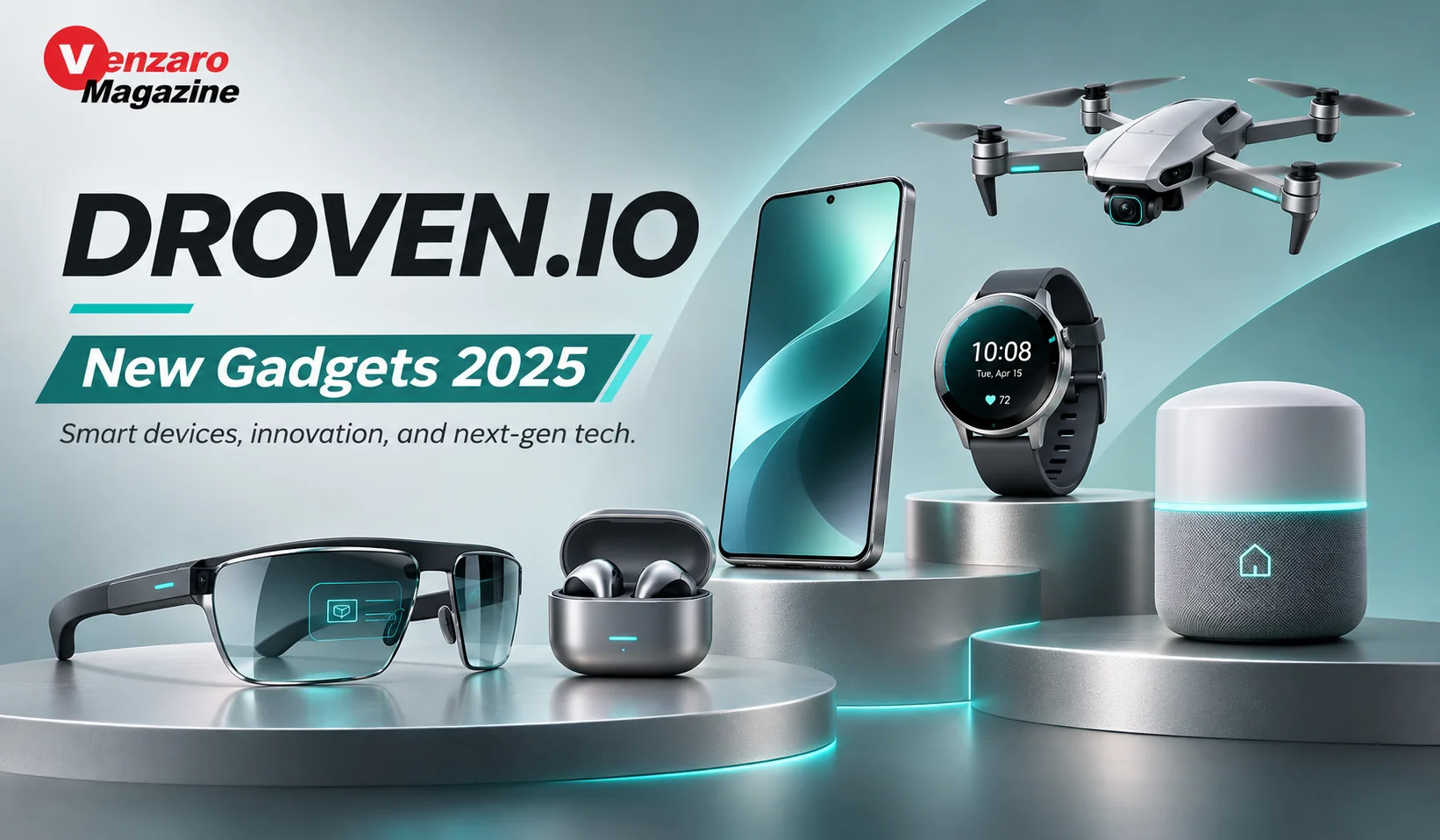
A pair of glasses that answers questions, a smartwatch capable of sending emergency messages without cellular coverage, and a home assistant that understands natural conversation might once have sounded like inventions from a science-fiction movie. In 2025, technologies like these became part of the consumer electronics market.
Interest in Droven.io new gadgets 2025 reflects the growing demand for devices that do more than offer impressive specifications. Consumers increasingly want technology that saves time, simplifies daily routines, and connects naturally with products they already own.
Droven.io is a technology-focused publication covering artificial intelligence, emerging devices, software, and digital innovation. Its gadget coverage highlights several developments that shaped the market during 2025. However, the website is an information publisher, not a manufacturer selling its own range of electronics.
The most interesting story behind these gadgets is how technology began moving away from traditional screens and into objects people use throughout the day.
When Gadgets Stopped Waiting for Instructions
For years, most consumer electronics operated through a simple pattern: users gave commands, and devices responded. Smart speakers played requested songs, watches counted steps, and security cameras recorded movement.
During 2025, manufacturers increasingly introduced artificial intelligence designed to understand context rather than respond only to rigid instructions.
Google announced Gemini for Home in August 2025, introducing a more conversational assistant for managing connected devices and household routines. Amazon also expanded its approach to AI-powered home assistance through Alexa+.
These developments helped make ordinary voice interactions more flexible. A user could ask a home assistant to adjust several devices together instead of issuing separate commands for every light, thermostat, or speaker.
The improvement was not universal, and advanced features sometimes required subscriptions. Nevertheless, the direction was clear: smart devices were becoming less dependent on memorized commands.
The Glasses That Made Smartphones Feel Less Essential
Smart glasses were among the most interesting consumer technology developments associated with 2025.
Unlike conventional virtual reality headsets, modern smart glasses aim to provide useful features without completely separating users from their surroundings.
The Ray-Ban Meta range demonstrated the appeal of combining cameras, microphones, speakers, and voice assistance in familiar eyewear. Oakley Meta HSTN, introduced in 2025, brought a sport-oriented design to the category.
Meta also introduced Ray-Ban Display glasses, featuring a small integrated visual display. This represented a more ambitious approach to wearable information, allowing certain details to appear within the user’s field of view.
These products serve different purposes. Some prioritize photography and hands-free communication, while others provide visual notifications or entertainment displays.
The practical challenge remains balancing capability with comfort. Battery life, weight, prescription compatibility, recording privacy, and cost can determine whether smart glasses become everyday accessories or occasional gadgets.
The Wrist Became a More Capable Health Companion
Wearable technology continued moving beyond basic step counting and workout reminders.
Apple introduced the Watch Ultra 3 in September 2025, adding satellite communication capabilities, expanded health features, and a battery rated for up to 42 hours of normal use.
Samsung’s Galaxy Watch8 and Google’s Pixel Watch 4 also reflected the industry’s emphasis on improved health information, fitness tracking, and connected experiences.
These developments made wearables more useful for people interested in understanding activity patterns, sleep quality, and changes in certain physiological measurements.
However, an important distinction remains between wellness tracking and medical diagnosis.
A smartwatch may provide alerts about possible health concerns, but it cannot replace professional assessment. The FDA has specifically warned that smartwatches and smart rings claiming to measure blood glucose independently without piercing the skin should not be relied upon.
For consumers, reliable health features and regulatory authorization are more important than impressive marketing promises.
Small Screens Were Giving Way to Bigger Experiences
Portable projectors attracted attention because they offered an alternative to permanently installed televisions.
Compact entertainment devices increasingly combined projection technology with wireless connectivity, integrated speakers, and streaming applications.
For apartment residents, travelers, and people with limited space, a projector can provide a flexible way to enjoy movies or presentations without dedicating an entire wall to a television.
Yet the technology still involves compromises.
Brightness has a major effect on picture quality, particularly in rooms with daylight. Battery-powered projectors may also deliver less brightness than larger plug-in models, while built-in speakers cannot always match dedicated audio equipment.
The most useful projector is therefore not necessarily the smallest. It is the one suited to the environment where it will actually be used.
A Smarter Home Should Require Less Attention, Not More
Smart home technology became more sophisticated during 2025, particularly through improvements in connected cameras, voice assistants, and device automation.
Google introduced new Nest cameras and a video doorbell designed to work with its developing Gemini-powered home ecosystem.
Modern security products increasingly distinguish between people, vehicles, animals, and ordinary movement. This can make notifications more useful by reducing some unnecessary alerts.
At the same time, smart kitchens continued incorporating connected ovens, appliances, and cooking systems that help manage routine tasks.
However, convenience alone does not guarantee a worthwhile purchase. A connected kitchen appliance may be unnecessary if its smart features add complexity without solving a real problem.
Compatibility is equally important. The Matter smart home standard helps different manufacturers’ products work together, but buyers still need to confirm which features their chosen devices support.
A connected home works best when technology becomes less noticeable rather than demanding constant interaction.
The Devices That Represented 2025’s Biggest Changes
Several real products help illustrate the technologies discussed in Droven.io’s gadget coverage.
| Gadget | Standout feature | Ideal user |
|---|---|---|
| Ray-Ban Meta Display | In-lens information display | Smart glasses enthusiasts |
| Apple Watch Ultra 3 | Satellite connectivity | Outdoor adventurers |
| Samsung Galaxy Watch8 | Health and fitness tracking | Samsung and Android users |
| Google Pixel Watch 4 | Connected health and AI features | Pixel phone users |
| Oakley Meta HSTN | Hands-free camera and audio | Active lifestyles |
| Nintendo Switch 2 | Updated portable gaming | Console gamers |
These products represent different needs rather than a universal ranking. Their specifications, availability, and regional support should always be checked against manufacturer information.
A More Intelligent Device Isn’t Always a Better Purchase
Technology companies frequently highlight AI capabilities because they attract attention. However, artificial intelligence does not automatically make a gadget more useful.
A device that summarizes notifications may save time, while a product that adds an unnecessary assistant to a simple household tool may offer little practical benefit.
The difference becomes clear when considering everyday use.
Someone who frequently travels may appreciate translation features or satellite connectivity. A person who works from home might benefit more from reliable audio equipment or an improved monitor.
Likewise, a smartwatch with extensive fitness features may be unnecessary for someone who only wants notifications and basic activity information.
The strongest purchasing decisions begin with an actual need, followed by an examination of whether the technology solves it effectively.
What Droven.io Gets Right About Gadget Discovery
Droven.io organizes its coverage around subjects such as artificial intelligence, technology news, digital transformation, and product reviews.
Its 2025 gadget discussions highlight relevant areas, including wearable devices, AI-assisted home technology, smart entertainment, and connected security products.
That approach can help readers discover categories they may not have previously considered.
However, a technology overview is different from an independently tested product review. Precise battery measurements, performance benchmarks, repairability assessments, and long-term reliability information require detailed testing.
Some product names appearing in online descriptions of Droven.io’s gadget coverage are also difficult to match with official manufacturer listings.
For that reason, readers should use the publication to explore ideas while confirming individual models through official specifications and credible hands-on testing.
This distinction is particularly important when purchasing expensive electronics.
Five Questions Worth Asking Before Buying Yesterday’s New Technology
By November 2026, many gadgets introduced during 2025 have become previous-generation products. That does not automatically make them outdated.
In some cases, older devices offer better value after prices fall.
Before choosing one, consider these practical questions:
- Will it remain supported? Check software and security update commitments.
- Does it require a subscription? Calculate the ongoing cost of premium features.
- Will it work with existing devices? Confirm phone, operating-system, and smart home compatibility.
- Can it be repaired? Examine battery replacement, warranty, and service availability.
- Is the newer version meaningfully better? Compare useful improvements rather than marketing language.
A slightly older gadget with dependable performance can be a better purchase than a new model offering features that rarely get used.
Frequently Asked Questions About Droven.io New Gadgets 2025
What is Droven.io new gadgets 2025?
It refers to gadget and technology coverage associated with Droven.io, particularly smart devices, AI innovations, wearables, connected homes, and consumer electronics relevant to 2025.
Does Droven.io manufacture gadgets?
No. Droven.io operates as a technology content publication rather than an established consumer electronics manufacturer.
Which gadgets stood out in 2025?
Notable releases included Apple Watch Ultra 3, Google Pixel Watch 4, Samsung Galaxy Watch8, Meta’s new smart glasses, and Nintendo Switch 2.
Are AI-powered gadgets worth buying?
They can be useful when their features solve genuine problems. Value depends on reliability, privacy, compatibility, pricing, and how frequently those features are used.
Can readers purchase gadgets directly from Droven.io?
The website primarily publishes technology content. It does not present itself as an official electronics retailer with a conventional gadget storefront.
Is information from Droven.io enough to choose a product?
It can provide an introduction to technology categories, but buyers should confirm exact specifications and compare independent product testing before making expensive purchases.
The Innovation That Matters Most Is the One People Actually Use
Looking back at 2025 reveals a significant shift in consumer electronics. Gadgets were becoming more conversational, more portable, and increasingly capable of providing information without requiring users to sit in front of a conventional screen.
Smart glasses explored new ways to interact with digital content. Wearables introduced more advanced safety and wellness features. Connected homes became more responsive, while portable entertainment devices offered greater flexibility.
The technology coverage associated with Droven.io new gadgets 2025 reflects these developments, but the lasting value of any device depends on what happens after the excitement of its launch fades.
A useful gadget continues improving everyday life long after it stops appearing in headlines. That is the standard by which the most successful innovations of 2025 deserve to be remembered.
More Explore:
Social Media Stuff EmbedTree: Features, Uses, and Complete Guide for 2026
StudiosoApp.com: Understanding the Music Education App, Features and Current Status