





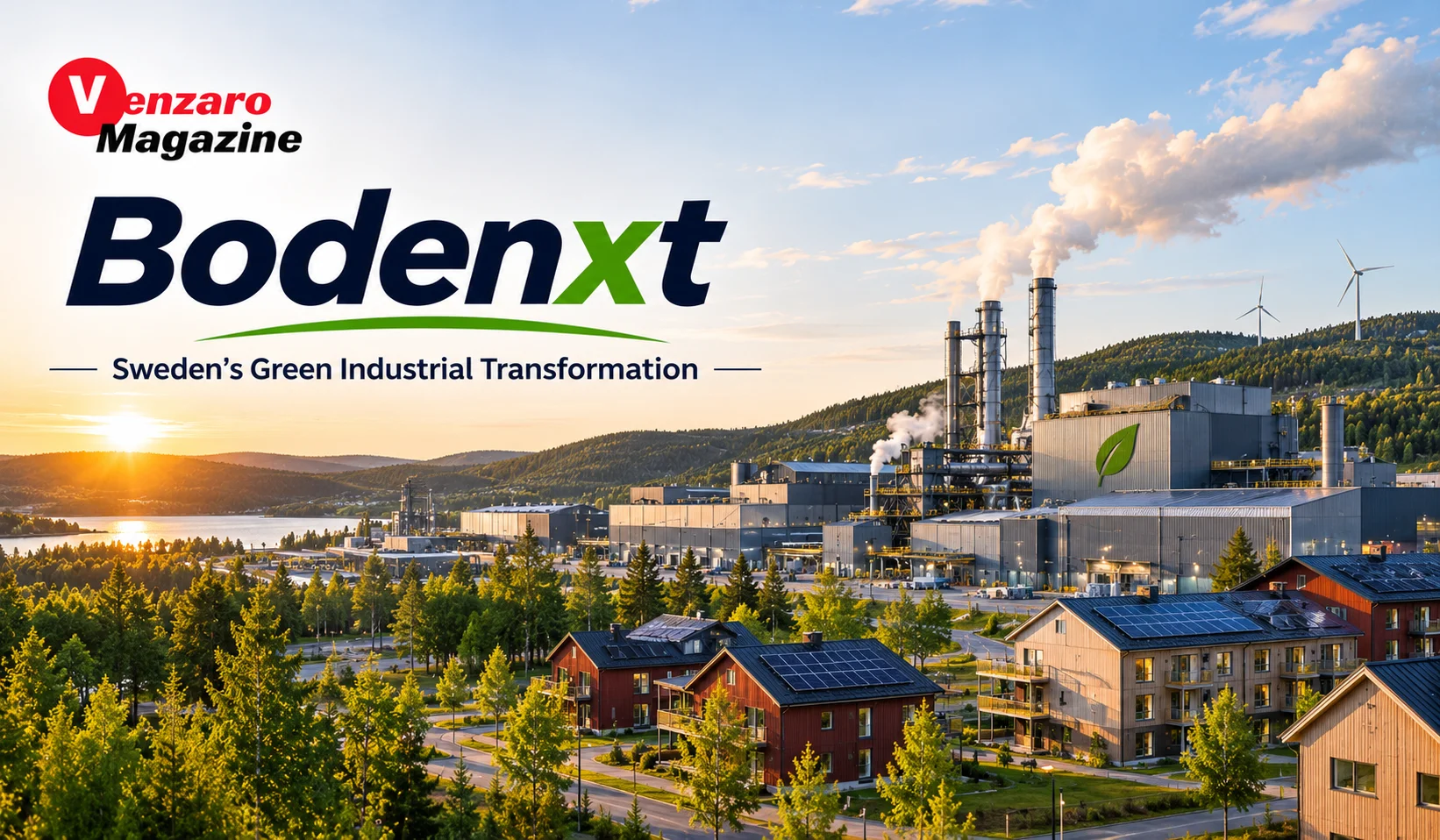
What happens when a relatively small town suddenly becomes the centre of one of Europe’s most ambitious industrial transformations? New investment brings the possibility of employment, business expansion, and cleaner production. Yet it also creates immediate questions about housing, infrastructure, education, and whether the community can accommodate rapid growth without losing the qualities that make it a desirable place to live.
This is the challenge behind Bodenxt, a development platform established by the Municipality of Boden in northern Sweden. Rather than representing a conventional technology company or downloadable application, Bodenxt coordinates and communicates the municipality’s response to major industrial and social changes taking place in the region.
Its work connects sustainable industry with the everyday requirements of a growing community. New factories need employees, employees need homes, families need schools, and expanding businesses need reliable infrastructure. Bodenxt brings these interconnected priorities into a broader development strategy, making it an interesting example of how industrial investment can reshape an entire municipality.
A Small Northern City Facing Decades of Change in Just a Few Years
Boden is located in Norrbotten County, a region of northern Sweden known for its forests, natural resources, established industrial activity, and strategic importance.
For many years, the municipality has been associated with military activity, regional services, and the economic characteristics of northern Swedish communities. However, substantial investment in low-emission industry has introduced new opportunities and pressures.
The municipality describes the ongoing transformation as development occurring at a pace comparable to roughly twenty years of normal community change compressed into a much shorter period.
This acceleration creates a complex planning challenge.
An expanding industrial economy cannot function effectively if residential construction, transportation, public services, and workforce development fail to keep pace.
Bodenxt exists to help coordinate these different aspects of growth rather than allowing individual projects to develop without consideration of their wider consequences.
What Bodenxt Actually Is, Beyond the Name
The name Bodenxt combines the identity of Boden with a forward-looking approach to development.
Official municipal information describes it as a platform for the extensive societal transformation taking place in Boden. Its role involves coordinating activities, improving communication, and bringing different stakeholders together around shared development priorities.
These stakeholders include local government, businesses, public institutions, educational organizations, and other participants involved in regional growth.
Bodenxt should not be confused with an artificial intelligence application, blockchain platform, or independent software subscription service. Although some online descriptions use such terminology, its documented purpose concerns physical, economic, and social development within the municipality.
The platform focuses on four closely connected areas: workforce skills, housing and living conditions, business development, and infrastructure.
Together, these priorities help explain why Bodenxt extends well beyond environmental branding.
The Green Steel Investment That Changed Boden’s Direction
One of the strongest forces behind Boden’s transformation is the industrial project developed by Stegra, previously known as H2 Green Steel.
The company is developing a large-scale steel production facility intended to substantially reduce emissions compared with conventional coal-based steelmaking.
Traditional steel production commonly relies on coal or coke during ironmaking, contributing significantly to industrial carbon dioxide emissions.
Stegra’s approach uses hydrogen-based direct reduction of iron alongside electric arc furnace technology, with the goal of reducing dependence on fossil-based production methods.
The project has attracted attention because steel is essential to construction, transportation, manufacturing, and infrastructure, yet conventional production remains emissions-intensive.
For Boden, the importance of the facility extends beyond its environmental ambitions.
A project of this scale requires construction workers, technical specialists, suppliers, transportation services, and supporting businesses. These activities can create economic opportunities while increasing demand for housing and public infrastructure.
Bodenxt helps the municipality address the wider consequences of this industrial expansion.
Why Building a Factory Is Only Half the Challenge
Industrial investment can move faster than the communities surrounding it.
A manufacturing facility may have a defined construction schedule, but increasing the capacity of a municipality involves many independent systems.
Homes must be planned and built. Transport networks may need improvements. Schools and healthcare services require sufficient staff and facilities. Local businesses must respond to changing demand.
A shortage in one area can affect progress elsewhere.
For example, employers may struggle to recruit skilled workers if suitable housing is unavailable. Meanwhile, residential development may be delayed if roads, utilities, or planning arrangements cannot support additional construction.
The significance of Bodenxt lies in recognizing these dependencies.
Its coordinated approach is intended to connect industrial growth with practical community development, reducing the risk that economic expansion creates problems faster than local institutions can manage them.
Housing Has Become One of the Most Important Pieces of the Puzzle
Housing is a particularly important consideration when a town expects substantial workforce growth.
Industrial projects often attract employees from other regions or countries. These workers may initially arrive alone, but some eventually relocate with partners or families.
That creates demand for different housing types, including temporary accommodation, rental apartments, and permanent family homes.
Simply increasing the number of available properties is not enough.
New residential areas also need transportation access, schools, utilities, public spaces, and proximity to employment opportunities.
Bodenxt’s housing-related work therefore connects with broader questions about how the municipality should develop.
The challenge is balancing immediate accommodation requirements with long-term community needs.
If development is planned only around temporary construction activity, the municipality could face difficulties when workforce requirements change. Sustainable planning must consider how new housing will serve residents beyond the initial industrial expansion.
A New Industrial Economy Needs Skills That Cannot Appear Overnight
Advanced industrial facilities require specialized expertise.
Hydrogen technology, electrical engineering, industrial automation, maintenance, logistics, and production management all depend on workers with appropriate training and experience.
Some of these skills may already exist within the regional workforce. Others require additional education, recruitment, or cooperation with training providers.
Bodenxt identifies skills supply as a central part of the municipality’s transformation.
This includes considering how businesses can find suitable employees and how educational institutions can prepare people for emerging opportunities.
Workforce development also involves attracting professionals from outside the region.
International recruitment introduces practical questions involving language, relocation, housing, and integration into the local community.
A successful workforce strategy must therefore consider both professional qualifications and the everyday conditions that help people establish long-term lives in Boden.
What Local Businesses Stand to Gain From the Transformation
Large industrial investment can create opportunities for businesses that are not directly involved in producing steel.
Construction companies may experience demand for building projects, while transport providers can support the movement of equipment and materials.
Restaurants, retailers, maintenance services, and professional organizations may also benefit from increased economic activity.
However, opportunities are not distributed automatically.
Smaller companies may need to adjust their capacity, workforce, or services to meet the requirements of expanding industries.
Bodenxt’s business-development focus reflects the importance of helping the local economy respond to these changes.
The broader objective is to encourage a diverse business environment rather than creating a community dependent entirely on one industrial employer.
Economic resilience becomes particularly important when major investment projects experience delays or changes in market conditions.
The Infrastructure Work That Residents May Notice First
The visible signs of community transformation are often found outside industrial facilities.
Road improvements, residential construction, transportation planning, and upgraded public services can affect residents long before an industrial project reaches full operation.
Boden’s growth creates additional demand for infrastructure capable of supporting both existing residents and newcomers.
Transportation is especially important because industrial areas, residential neighborhoods, and public services must remain accessible.
Utilities such as electricity, water, and wastewater systems also require appropriate capacity.
Infrastructure planning must account for present requirements and reasonable expectations about future development.
Building systems that are too limited can restrict growth, while poorly targeted investment may place unnecessary financial pressure on the community.
Bodenxt’s coordinated development approach helps connect these infrastructure questions with broader municipal priorities.
The Environmental Promise Comes With Practical Questions
Green industrial transformation is often discussed in terms of reduced emissions and new technologies.
However, environmental sustainability requires a wider assessment.
Industrial facilities consume resources, occupy land, and depend on transportation and energy systems. Housing expansion and infrastructure construction also have environmental effects.
Hydrogen-based steel production has the potential to reduce emissions associated with conventional ironmaking, particularly when hydrogen and electricity are produced using low-emission energy sources.
The actual environmental performance depends on factors such as energy supply, production efficiency, material sourcing, and operational conditions.
For Boden, environmental progress must therefore be considered alongside industrial development and community planning.
A sustainable transition should improve economic opportunities while managing environmental impacts and protecting quality of life.
The Risks That Come With Growing Too Quickly
Rapid development can create genuine opportunities, but it also introduces uncertainty.
Large industrial projects may encounter financing difficulties, construction delays, changing market conditions, or unexpected operational challenges.
These developments can affect employment forecasts, supplier demand, and the timing of related infrastructure projects.
Community growth also places pressure on local institutions.
Housing shortages, rising accommodation costs, workforce competition, and demand for public services may create difficulties if development occurs unevenly.
Several factors deserve continued attention:
- Whether industrial investment progresses according to revised plans.
- Whether enough suitable housing becomes available.
- How effectively local workers can access new employment opportunities.
- Whether infrastructure capacity expands alongside population needs.
- How environmental and economic objectives are balanced.
Bodenxt provides a framework for coordinating responses to these issues, but no planning platform can eliminate every uncertainty associated with a transformation of this scale.
Could Other Industrial Communities Learn From Bodenxt?
Boden’s experience has relevance beyond Sweden.
Communities around the world face similar challenges when major industrial investment arrives.
A new manufacturing facility may promise employment and economic growth, but its long-term impact depends on housing, education, infrastructure, and the capacity of local institutions.
The Bodenxt approach highlights the importance of treating these subjects as connected parts of one development process.
Other municipalities may draw lessons from the emphasis on cross-sector cooperation and integrated planning.
However, successful strategies cannot always be transferred directly between locations.
Population size, financing arrangements, national regulations, existing infrastructure, and local economic conditions influence what is practical.
The broader lesson is that industrial development and community development should advance together.
Questions People Commonly Ask About Bodenxt
What is Bodenxt?
Bodenxt is the Municipality of Boden’s platform for coordinating major industrial and societal transformation in northern Sweden.
Is Bodenxt a private company?
No. Its official identity is connected with municipal development rather than an independent commercial company.
Is Bodenxt an AI or software platform?
No verified official information identifies Bodenxt as an AI application or subscription software product. Its documented purpose concerns community development and the green transition.
How is Bodenxt connected to Stegra?
Stegra is developing a major low-emission steel facility in Boden. Bodenxt addresses the broader community changes associated with industrial investment, including housing, workforce development, infrastructure, and business opportunities.
What are Bodenxt’s main priorities?
Its principal areas include skills supply, housing and living conditions, business development, and infrastructure planning.
Will Bodenxt create employment?
Bodenxt itself is a coordination platform. Employment opportunities arise through industrial projects, construction, suppliers, and related economic activity associated with Boden’s transformation.
Why is Boden important to Sweden’s green transition?
Boden hosts substantial investment in hydrogen-based steelmaking and related development, making it an important location in Sweden’s efforts to support lower-emission industrial production.
The Future of Bodenxt Depends on More Than Industrial Success
Bodenxt demonstrates why major industrial transformation cannot be measured only through factory construction, investment announcements, or projected employment numbers.
The wider test is whether a community can accommodate growth while maintaining functioning services, suitable housing, economic opportunities, and a healthy living environment.
Boden’s transition brings together environmental ambition and practical municipal responsibilities. Its industrial investments have created momentum, but the long-term outcome will depend on cooperation between businesses, public institutions, workers, and residents.
For other regions facing similar changes, Bodenxt offers an important planning perspective: industrial development should not be treated as separate from the community that supports it.
More Read: Mbaile: Understanding Its Identity, Meaning, and Digital Significance