









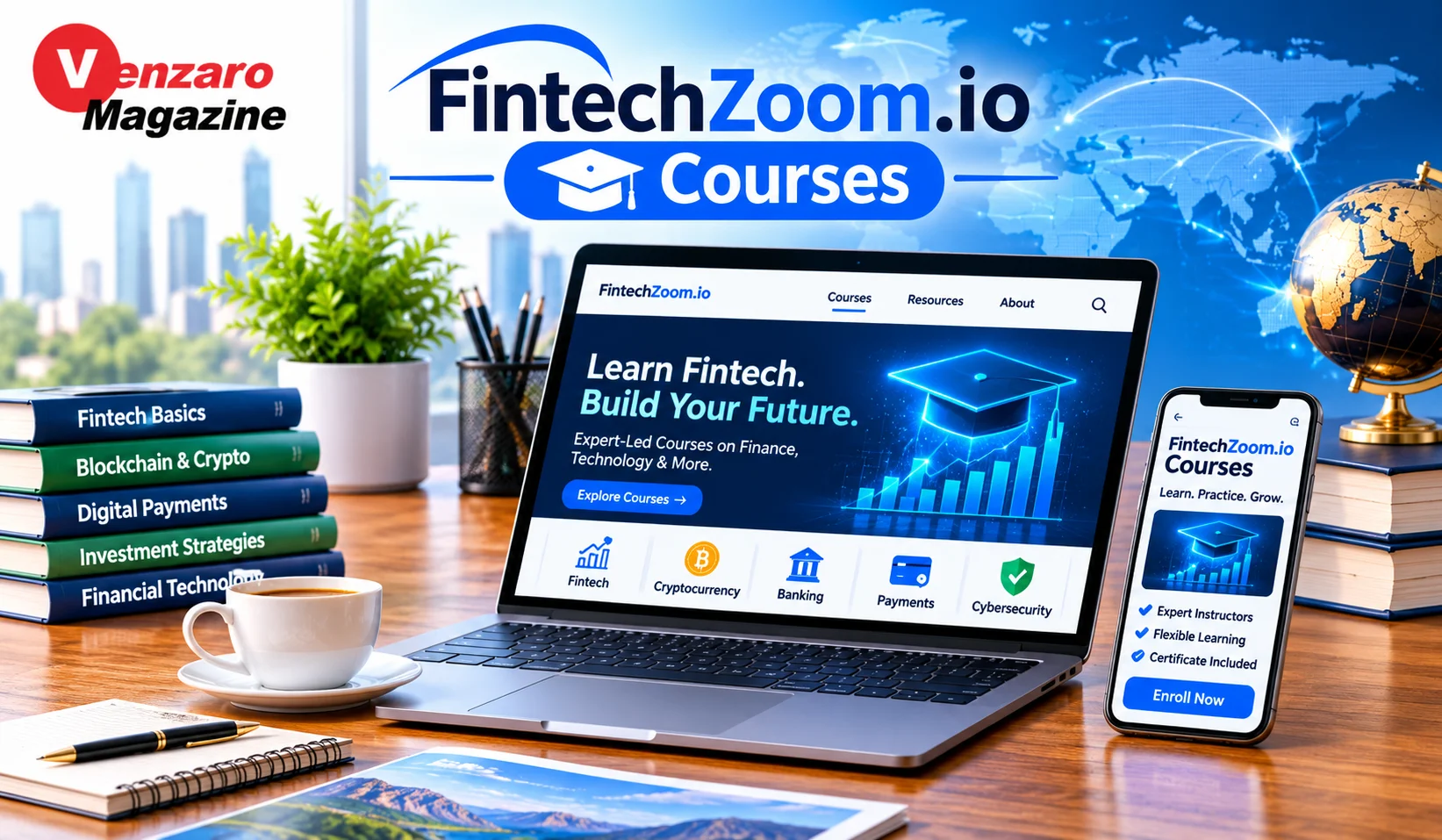
Making financial decisions becomes considerably easier when you understand the principles behind money management and financial markets. However, many beginners enter the world of investing without knowing how stocks work, why market prices fluctuate, or how to manage their finances effectively. FintechZoom.io Courses address these learning interests through online educational programs focused on financial literacy, stock market trading, and investing.
The platform presents its courses as flexible learning opportunities for people who want to improve their financial knowledge without following a traditional classroom schedule. Instead of concentrating on a single aspect of finance, its educational section introduces several subjects that serve different financial goals. Understanding what each program covers can help prospective learners decide whether the available material matches their experience and expectations.
What Is the Educational Approach Behind FintechZoom.io Courses?
FintechZoom.io combines financial information with an educational offering designed to make money-related subjects easier to understand. Its Courses section promotes learning opportunities for beginners as well as individuals who already have some familiarity with financial markets.
The central idea is to develop practical knowledge that learners can apply when managing personal finances or studying investment opportunities. Topics such as budgeting, saving, trading strategies, and portfolio management form part of the platform’s advertised educational direction.
One aspect worth understanding is that financial literacy, investing, and trading are different disciplines. Someone trying to manage monthly expenses has different learning requirements from an individual interested in analyzing stock market movements. FintechZoom.io separates these interests into distinct course categories rather than treating them as interchangeable skills.
Three Learning Paths That Address Different Financial Goals
The course catalog identifies three main educational areas. Each has a different purpose, making it important to consider personal learning objectives before choosing a program.
Financial Literacy: Building Better Money Habits
Financial literacy provides the foundation for almost every important financial decision. It involves understanding income, expenses, savings, borrowing, credit, and the relationship between spending habits and long-term financial stability.
FintechZoom.io’s Financial Literacy course is intended to introduce these concepts through structured lessons and practical learning material. Its advertised subjects include budgeting, saving, expense management, credit, debt reduction, and basic investing.
This subject can be particularly relevant to students entering independent financial life, working professionals managing regular income, and individuals who want to become more organized with their money.
Rather than concentrating exclusively on investment returns, financial literacy encourages people to understand their existing financial position. Knowing how much money comes in, where it goes, and what can realistically be saved creates a stronger starting point for future decisions.
Stock Market Trading: Understanding Short-Term Market Activity
Trading involves buying and selling financial instruments with the intention of benefiting from price movements. Unlike long-term investing, which often focuses on gradual portfolio development, trading generally requires closer attention to market behavior and timing.
FintechZoom.io lists Stock Market Trading as a separate learning category. Its stated objective is to introduce learners to trading concepts and the use of financial technology when examining market opportunities.
Someone exploring this subject should develop an understanding of market orders, price movements, trading strategies, and risk management. Learning to recognize that a potentially profitable opportunity can also produce losses is equally important.
Trading education should never be confused with a promise of consistent profits. Financial markets are unpredictable, and even experienced participants can make incorrect decisions. Developing a disciplined approach to risk is therefore just as important as understanding technical concepts.
Stock Market Investing: Developing a Longer-Term Perspective
Investing requires a different mindset from short-term trading. Rather than concentrating primarily on immediate price changes, investors generally examine the underlying value of assets and consider how their portfolios might perform over extended periods.
The Stock Market Investing course offered by FintechZoom.io is presented as an educational option for beginners and individuals with existing investment knowledge.
Useful concepts within this area include diversification, asset allocation, investment research, portfolio planning, and understanding the relationship between potential returns and financial risk.
A learner interested in building long-term financial knowledge may find this subject more relevant than active trading. However, investment decisions should always reflect individual circumstances, financial objectives, and the possibility of losing money.
How the Learning Experience Is Designed
Online education offers flexibility that traditional classroom schedules cannot always provide. FintechZoom.io advertises a self-paced learning environment, allowing participants to study according to their own availability.
Its course pages also describe several learning features intended to support the educational process:
- Structured lessons: Information is arranged around specific financial subjects.
- Practical examples: Real-world scenarios help connect financial concepts with everyday situations.
- Interactive exercises: Quizzes and activities are promoted as ways to reinforce understanding.
- Learning resources: Additional materials are described as part of the educational experience.
- Flexible access: The platform advertises access to learning materials without a fixed classroom schedule.
- Learner support: The website describes assistance for students who have questions during their studies.
These features can make financial subjects more approachable, particularly for people who prefer independent learning. Nevertheless, the actual quality of an educational program depends on the depth of its lessons, the accuracy of its material, and the expertise of the people responsible for teaching it.
Who Should Consider Exploring These Courses?
Not every financial course serves the same audience. Choosing an appropriate subject requires identifying the knowledge gap a learner wants to address.
Students and beginners: Financial literacy can provide a useful introduction to budgeting, saving, credit, and personal financial planning.
Working professionals: People with regular incomes may be interested in improving their money-management habits and understanding long-term financial goals.
Aspiring investors: The investing program may be relevant to individuals who want to understand portfolio development and the fundamentals of stock market participation.
Trading enthusiasts: Those interested in active market participation may prefer the trading category, provided they understand the associated risks.
People with advanced financial qualifications or extensive market experience should examine the actual course curriculum before enrolling. Introductory material may not provide the technical depth they require.
Important Details to Check Before Paying for a Course
An attractive course description is only one part of evaluating an educational program. Prospective learners should also examine the information that determines its practical value.
For FintechZoom.io Courses, several details deserve attention. The public course descriptions promote expert-led guidance, but prospective students should request the instructors’ names and professional backgrounds. Detailed lesson outlines are also useful for determining whether the material matches the advertised learning objectives.
Pricing should be confirmed directly before making a payment, along with any subscription conditions or additional charges. The website also advertises a satisfaction guarantee, so learners should obtain the complete written refund conditions rather than relying on a short promotional description.
Certificates deserve similar consideration. A course completion certificate may demonstrate participation, but it should not automatically be treated as an accredited academic qualification or a regulated financial certification.
Taking these precautions helps learners make decisions based on the actual educational offering instead of marketing expectations.
Why Financial Education Should Continue Beyond a Single Course
Completing an online program does not automatically make someone a successful investor or an expert in personal finance. Financial knowledge develops through continued learning, careful observation, and the ability to apply concepts in different situations.
For example, understanding budgeting principles is useful, but maintaining a realistic budget requires consistent attention to spending patterns. Similarly, learning about stock market analysis does not eliminate uncertainty when prices move unexpectedly.
A sensible learning routine involves reviewing important concepts, following relevant market developments, and comparing different approaches before making financial decisions.
It is also important to distinguish education from personalized financial advice. Courses can explain how financial systems work, but they cannot automatically determine which investment choices are suitable for every individual.
Frequently Asked Questions About FintechZoom.io Courses
1. What courses does FintechZoom.io offer?
Its main course categories are Financial Literacy, Stock Market Trading, and Stock Market Investing. Each addresses a different area of financial education.
2. Are FintechZoom.io Courses suitable for beginners?
The platform describes its programs as suitable for beginners as well as people with existing financial knowledge. Reviewing the individual curriculum can help determine the appropriate starting point.
3. Can I learn about personal finance through FintechZoom.io?
Yes. The Financial Literacy program is specifically presented around budgeting, saving, expense management, credit, debt, and basic investment concepts.
4. Do the courses provide certificates?
The platform promotes certificates as part of its educational offering. However, learners should verify the certificate’s exact status and should not assume that it carries external academic accreditation.
5. Is stock trading different from stock market investing?
Yes. Trading generally focuses on shorter-term price movements, whereas investing usually involves evaluating assets and developing a portfolio with longer-term objectives.
6. Should I enroll without checking the course details?
No. Review the complete syllabus, instructor information, pricing, access conditions, and refund policy before making a payment.
Final Thoughts
FintechZoom.io Courses bring together three important areas of financial education: everyday money management, active trading, and long-term investing. This separation gives learners an opportunity to explore subjects according to their interests rather than following a single learning path.
For beginners, understanding personal finance may be the most sensible starting point. Those interested in financial markets can then explore investing or trading after developing a stronger foundation.
More Read:
FintechZoom.com SP500: What the Numbers Tell You—and What They Don’t
FintechZoom.io Nasdaq: Market Data, Charts, Analysis & Guide