








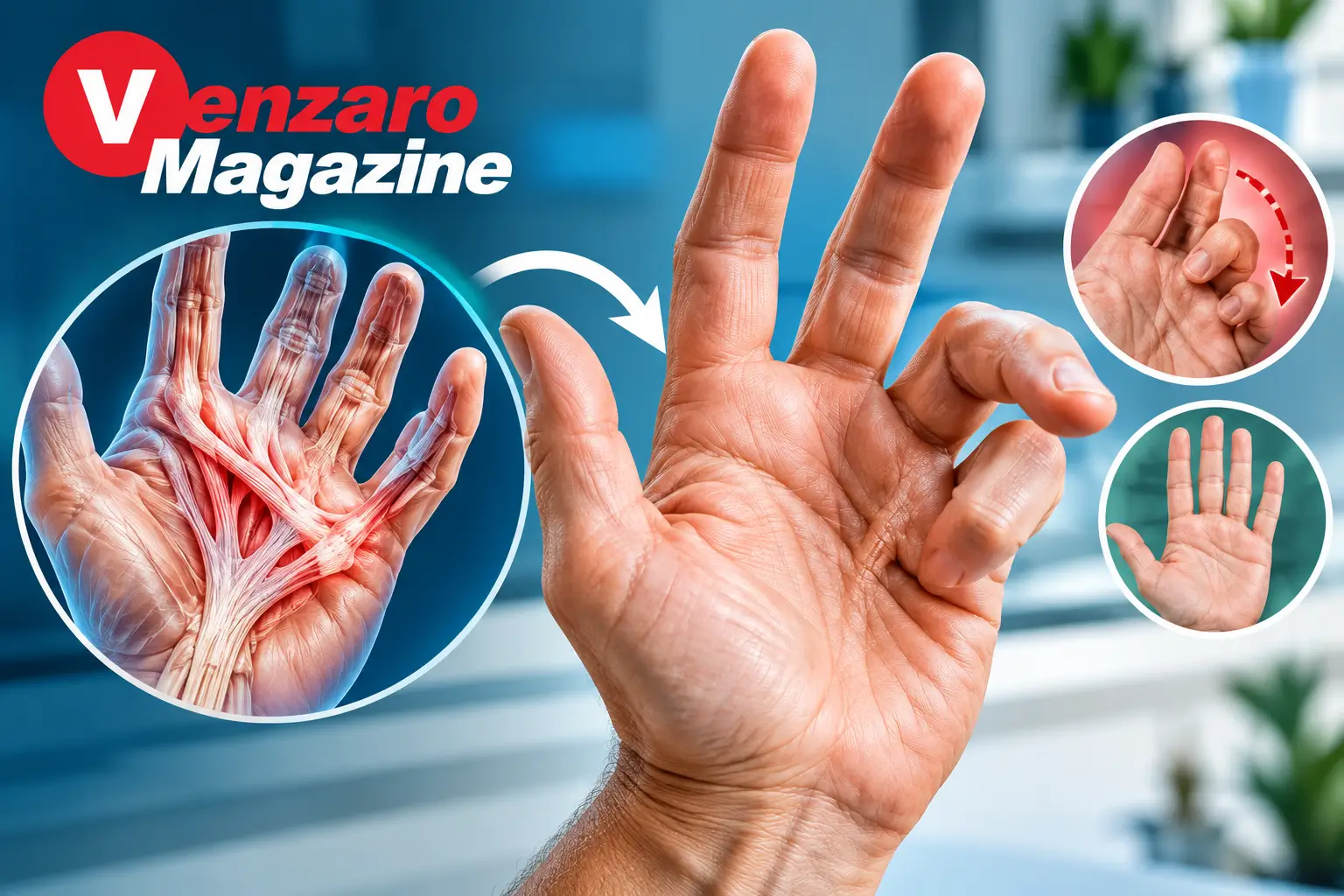
“Loguytren problems” does not appear to be the recognized medical name of a hand disorder. The term people are usually looking for is Dupuytren’s disease, also called Dupuytren’s contracture once the condition begins preventing the fingers from straightening normally. Dupuytren’s disease affects the connective tissue beneath the skin of the palm. It often starts quietly with a small firm lump or nodule, usually around the base of the ring or little finger. Over months or years, abnormal tissue can develop into thick cords that gradually shorten and pull one or more fingers toward the palm. The result can range from a harmless lump that causes little trouble to a fixed contracture that makes ordinary activities frustrating. A person may struggle to place the hand flat on a table, put on gloves, reach into a pocket, wash the face, hold larger objects or perform work that requires the fingers to open fully. The condition is not cancer, and many people with mild Dupuytren’s disease never need an operation. The difficult part is that progression is unpredictable. One person’s nodule may remain relatively stable for years while another person’s finger gradually becomes increasingly bent. That is why understanding the actual problem matters more than trying to judge the condition from the appearance of one lump.
Is Loguytren a Real Medical Condition?
There does not appear to be a recognized condition formally called Loguytren disease or Loguytren contracture in major medical references.
The established term is Dupuytren’s disease.
“Loguytren” may simply be a spelling or hearing error, particularly because Dupuytren is not pronounced in the way many English speakers expect from its spelling.
This distinction matters when looking for health information. Searching an incorrect term can lead to low-quality pages, while searching “Dupuytren’s disease” or “Dupuytren’s contracture” leads to established medical resources and hand specialists.
If “Loguytren” was written on a medical report, referral or prescription rather than heard in conversation, the wording should be checked directly with the healthcare professional because another condition may have been intended.
What Is Dupuytren’s Disease?
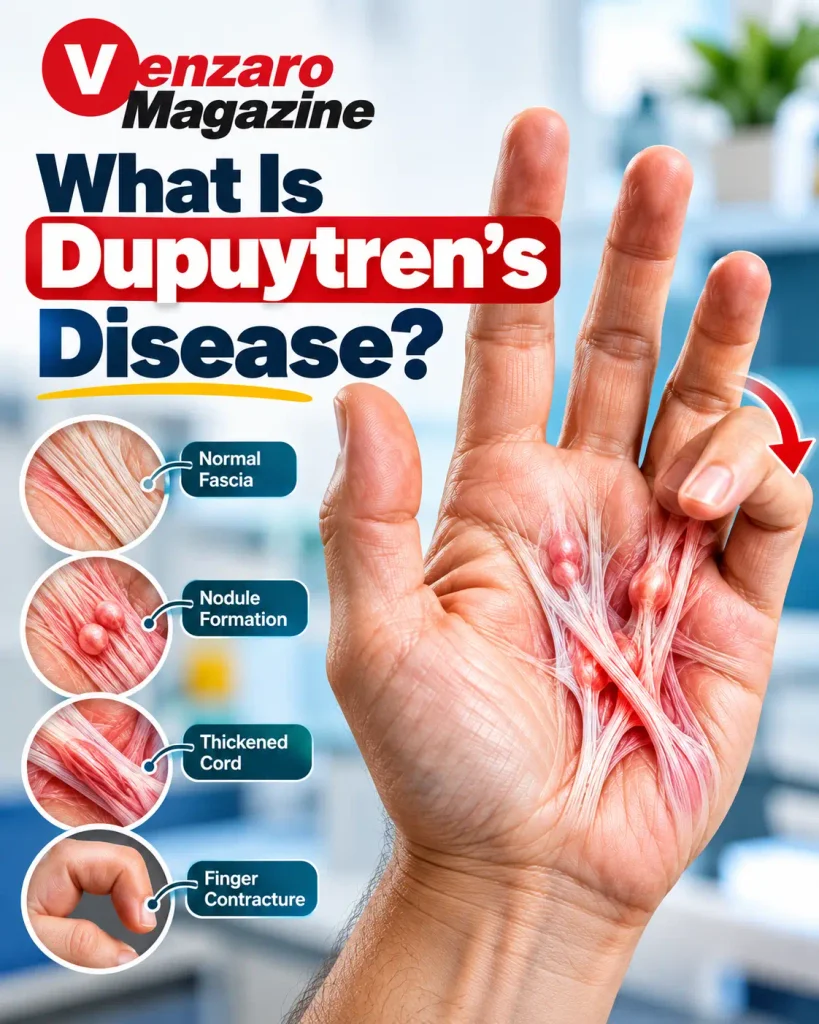
Dupuytren’s disease is a disorder involving the fascia beneath the skin of the palm.
Fascia is connective tissue that helps support structures in the hand.
In Dupuytren’s disease, this tissue becomes abnormally thickened. Small nodules can form first. These may later develop into firm cords extending toward the fingers.
As a cord tightens, it can begin pulling a finger downward.
At this stage, the person may no longer be able to completely straighten the affected finger.
That loss of extension is the contracture.
This is why “Dupuytren’s disease” and “Dupuytren’s contracture” are closely related but are not perfectly interchangeable terms. Disease can exist before a significant contracture develops.
What Problems Does Dupuytren’s Cause?
The biggest problem is usually loss of normal finger extension rather than severe pain.
A mild nodule in the palm may cause almost no functional difficulty.
As the tissue contracts, however, everyday tasks can become awkward.
Putting the hand into a trouser pocket can become difficult because a bent finger catches on the fabric.
Putting on gloves can become frustrating.
Washing the face may become awkward because a finger that cannot straighten gets in the way.
Placing the palm flat against a surface can become impossible.
Grasping some large objects may become more difficult.
Handshakes, sports, manual work, musical instruments and activities requiring precise hand positioning can also become affected.
The practical impact depends on which finger and joint are involved and how far the contracture has progressed.
What Does Dupuytren’s Look Like at the Beginning?
Early Dupuytren’s disease often looks much less dramatic than photographs of advanced contracture.
A small, firm lump may appear beneath the skin of the palm.
It can resemble a callus.
The skin may also develop small pits or puckered areas.
Some people notice tenderness around a new nodule, while others notice the lump without pain.
At this stage, the fingers may still straighten completely.
That distinction is important because the presence of a nodule does not automatically mean a severely bent finger will follow immediately.
Dupuytren’s can progress slowly, remain stable for a long time or develop differently from one person to another.
Which Fingers Are Usually Affected?
The ring finger and little finger are the most commonly affected.
MedlinePlus describes the fourth, or ring, finger as the most frequently involved, followed by the fifth, or little, finger.
Other fingers can be affected as well.
The thumb is less commonly involved but is not completely excluded.
The condition may begin in one hand and later affect both.
This pattern is useful when recognizing possible Dupuytren’s, but it cannot diagnose the condition by itself.
A bent little finger can have causes other than Dupuytren’s.
Does Dupuytren’s Affect Both Hands?
It can.
Some people initially notice a lump or contracture in only one palm.
MedlinePlus reports that many affected individuals eventually develop features in both hands.
The severity does not necessarily have to be identical.
One hand can have an obvious contracture while the other has only a small nodule.
This means checking both hands can be useful even when only one side is creating a noticeable problem.
What Are the Main Symptoms?
The condition often develops in stages rather than appearing as a suddenly bent finger.
The first noticeable change may be a firm nodule beneath the palm.
Skin around it can become dimpled or puckered.
A thick cord may later become noticeable beneath the skin.
As that cord tightens, one or more fingers become increasingly difficult to straighten.
Eventually the finger may remain bent toward the palm even when the person deliberately tries to extend it.
Some people also experience tenderness, aching, itching or burning, particularly around nodules.
Pain, however, is not required for Dupuytren’s disease to be present.
Is Dupuytren’s Painful?
Dupuytren’s is often thought of as a relatively painless condition, but that does not mean everyone experiences it without discomfort.
MedlinePlus reports that around one-quarter of affected people experience uncomfortable inflammation or sensations such as tenderness, burning or itching.
Early nodules can sometimes feel sore.
Pressure or tension may also be noticeable when attempting to straighten a contracting finger.
For many people, the more significant long-term problem is restricted movement rather than pain.
New severe pain, marked redness, warmth or sudden swelling deserves medical assessment because those features may point toward another hand problem rather than being assumed to be Dupuytren’s.
What Causes Dupuytren’s Disease?
The exact biological cause is not completely understood.
Genetics clearly appears to play an important role.
Dupuytren’s frequently runs in families, and the condition is particularly associated with people of Northern European ancestry.
That does not mean someone without an affected relative cannot develop it.
It also does not mean everyone who inherits a genetic susceptibility will develop severe contracture.
The disease appears to result from an abnormal process involving connective tissue in the palm, but predicting exactly who will develop progressive contracture remains difficult.
Is Dupuytren’s Hereditary?
There is a strong hereditary component.
A person with biological relatives who have Dupuytren’s disease has an increased risk.
Family history can therefore be useful information to mention when seeing a doctor about a suspicious palm nodule.
Sometimes a person recognizes the condition only after remembering that a parent or grandparent had similarly bent fingers later in life.
Genetics is not the entire explanation, though.
Other factors are associated with increased risk, and disease severity can differ dramatically even within the same family.
Who Is Most at Risk?
Dupuytren’s disease becomes more common with age and is more common in men.
Northern European ancestry and family history are established risk factors.
Medical resources also describe associations with conditions or behaviors including diabetes, smoking and heavy alcohol use.
Some sources note associations with epilepsy or seizure disorders as well.
An association does not necessarily mean one factor directly caused an individual’s Dupuytren’s.
A person can develop the condition without diabetes, smoking or excessive alcohol consumption.
Likewise, having one of those risk factors does not mean Dupuytren’s will inevitably develop.
Can Diabetes Cause Dupuytren’s Problems?
Diabetes is associated with a higher likelihood of Dupuytren’s disease.
That does not mean every hand contracture in someone with diabetes is Dupuytren’s.
Diabetes can affect the hands in several different ways, so an examination remains important.
The relationship is better understood as increased risk rather than a simple cause-and-effect rule.
Someone with diabetes who notices new palm nodules or difficulty straightening the fingers should therefore mention both problems to their healthcare professional.
Does Alcohol Cause Dupuytren’s?
Heavy alcohol use has been associated with Dupuytren’s disease.
It would still be misleading to say that alcohol alone causes every case.
Many people with Dupuytren’s do not have alcohol use disorder, and many people who consume alcohol never develop Dupuytren’s.
The disease has a strong genetic component and likely reflects several interacting factors.
The same caution applies to smoking.
Both can be relevant risk factors without providing a complete explanation for why one particular person’s hand developed the condition.
Can Working With Your Hands Cause Dupuytren’s?
The relationship between manual work and Dupuytren’s has been debated.
Some evidence suggests heavy manual work or repeated exposure to vibration may be associated with greater risk, but Dupuytren’s should not simply be described as a repetitive-strain injury.
People who have never spent their careers doing heavy manual work can still develop it.
Its strong genetic association makes the disease fundamentally different from a simple injury caused by overusing the hand.
If symptoms appeared after an injury, a clinician may need to distinguish Dupuytren’s from scar tissue, tendon problems and other conditions.
Can an Injury Trigger Dupuytren’s?
People sometimes first notice Dupuytren-like changes after hand trauma or surgery.
That does not necessarily prove the injury created the disease from nothing.
Someone may already have had a predisposition or early changes that became more noticeable around the same period.
A lump appearing after an injury also has several possible explanations besides Dupuytren’s.
For that reason, a new post-injury palm lump should not be self-diagnosed solely from photographs online.
Is Dupuytren’s Cancer?
No. Dupuytren’s disease is not cancer.
The nodules and cords involved are benign.
This is an important reassurance because finding a new hard lump beneath the skin naturally makes some people worry about a tumor.
At the same time, not every lump in the hand is a Dupuytren’s nodule.
Cysts, calluses and other lesions can appear in similar areas.
A new or unexplained lump should therefore still be assessed if its identity is uncertain.
“Dupuytren’s is not cancer” is different from saying “every palm lump is harmless.”
What Else Can Look Like Dupuytren’s?
Several hand conditions can create lumps, stiffness or difficulty moving a finger.
Ganglion cysts can produce lumps.
Calluses can create thickened areas that resemble superficial nodules.
Trigger finger can interfere with smooth finger movement.
Arthritis can create stiffness and deformity.
Tendon problems can restrict movement.
Scar tissue following injury or surgery can contract.
Congenital finger differences can also cause a permanently bent appearance.
This overlap is why photographs and symptom lists are useful for orientation but not a substitute for examination.
Dupuytren’s vs Trigger Finger
These two conditions are often confused because both can interfere with finger movement.
Dupuytren’s involves abnormal thickening and contraction of fascia in the palm.
Trigger finger involves the tendon and its surrounding sheath.
A trigger finger often catches, clicks or locks during bending and straightening.
A Dupuytren’s contracture is more likely to produce a progressively fixed inability to straighten the finger, often accompanied by a palpable palm cord or nodule.
Someone can also have more than one hand problem at the same time, so symptoms should not be forced into one diagnosis without examination.
Dupuytren’s vs Arthritis
Arthritis primarily affects joints.
Dupuytren’s primarily involves connective tissue beneath the skin of the palm and fingers.
Arthritis may produce joint pain, swelling, stiffness and changes visible around the joints.
Dupuytren’s more characteristically produces palm nodules, cords, skin puckering and progressive flexion contracture.
Advanced cases of either condition can interfere with hand function, making self-diagnosis difficult.
The distinction matters because treatment is different.
What Is the Tabletop Test?
The tabletop test is a simple way of noticing whether finger contracture is beginning to interfere with full extension.
Place the affected hand palm-down on a flat table.
Try to rest the entire palm and fingers flat against the surface.
If the hand cannot lie flat because one or more fingers remain bent, the contracture may have progressed enough to deserve specialist assessment.
The test is useful for monitoring function, but it is not a complete diagnostic examination.
Passing the test does not necessarily mean there is no early Dupuytren’s disease because nodules can exist before significant contracture develops.
Can Dupuytren’s Stop Progressing?
Yes, progression is variable.
Some people develop nodules that change very little over long periods.
Others develop cords and contractures gradually over years.
A smaller group experiences more rapid progression.
This unpredictability is one reason immediate invasive treatment is not necessary for every newly discovered nodule.
Monitoring can be reasonable when the fingers remain functional and the condition causes little difficulty.
The important issue is noticing meaningful change rather than assuming that every early nodule will inevitably end in severe hand deformity.
What Happens If Dupuytren’s Gets Worse?
As the cord shortens, the affected finger becomes increasingly difficult to straighten.
Eventually it may remain permanently bent toward the palm.
This can interfere with daily activities even if the person can still grip objects reasonably well.
A bent finger can catch when reaching into a pocket.
It can interfere with washing the face.
Gloves become harder to wear.
Some sports and tools become awkward.
Tasks requiring the hand to spread flat can become particularly difficult.
Advanced joint contracture can also become harder to correct completely, which is one reason progression and function matter when deciding when to seek specialist advice.
Can Dupuytren’s Affect Grip?
Yes, although the effect varies.
Early disease may not affect grip at all.
Even someone with a moderate contracture may still be able to close the hand effectively because the disease pulls the fingers toward the palm rather than preventing flexion.
The problem often appears when the hand needs to open.
Gripping a small object may remain easy while grasping something large becomes awkward because the fingers cannot spread sufficiently.
Releasing objects can also become more difficult.
This explains why some people initially underestimate the condition: closing the hand still works, but normal opening gradually disappears.
Can Dupuytren’s Make Writing Difficult?
It can, particularly if contracture becomes significant.
Writing requires coordinated positioning of the fingers rather than simply making a fist.
A bent ring or little finger may interfere with how the hand rests against a surface.
More extensive disease can make gripping and manipulating a pen less comfortable.
The degree of difficulty varies depending on which finger is affected, hand dominance and severity.
Someone whose work depends heavily on precise hand movements may notice functional problems earlier than someone whose daily activities do not require full finger extension.
Problems With Gloves and Pockets
These sound like minor inconveniences until the contracture becomes significant.
A finger that remains bent can catch when sliding the hand into a pocket.
Gloves assume that each finger can enter a separate straight compartment.
A contracted finger may make that difficult or impossible.
These ordinary tasks are actually useful examples when explaining functional impairment to a doctor.
Treatment decisions are not based only on what a hand looks like.
How the condition affects everyday activities matters too.
Problems Washing the Face
Advanced Dupuytren’s can make face washing unexpectedly awkward.
If a finger cannot straighten, the bent finger may contact the face before the palm does.
Similar problems can appear when applying creams, shaving, grooming or performing other tasks close to the face.
This illustrates an important feature of Dupuytren’s.
The disease may not remove strength from the hand, but changing the hand’s shape can still create significant disability.
Can Dupuytren’s Affect Work?
Yes.
The impact depends heavily on the job.
A musician may be affected by a relatively small loss of finger extension.
A mechanic may struggle with certain tools.
A healthcare professional may have difficulty putting on gloves.
Someone working with keyboards may experience different problems from someone handling large objects.
Manual occupations can become particularly frustrating when the hand needs to open around tools or fit into narrow spaces.
This is why treatment decisions should consider the individual’s actual functional requirements rather than only the angle of the finger.
Can Dupuytren’s Affect the Feet?
A related fibrous condition can occur in the soles of the feet.
This is known as Ledderhose disease or plantar fibromatosis.
People with Dupuytren’s disease have an increased likelihood of certain related connective-tissue disorders.
The foot condition usually produces firm nodules in the plantar fascia rather than simply duplicating a bent-finger problem in the toes.
Foot lumps have many possible causes, so someone with Dupuytren’s should not automatically assume every new foot lump is Ledderhose disease.
What Are Garrod Pads?
Garrod pads are firm nodules that develop over the knuckles.
They are associated with the same broader group of fibrous tissue abnormalities seen with Dupuytren’s disease.
Their location helps distinguish them from the classic Dupuytren’s nodule, which usually appears in the palm.
Someone can have these related findings without every area progressing in exactly the same way.
A clinician familiar with hand disorders can usually distinguish them from other causes of knuckle swelling.
Dupuytren’s and Peyronie Disease
Men with Dupuytren’s disease have an increased association with Peyronie disease, another condition involving abnormal fibrous tissue.
Peyronie disease affects the penis and can cause abnormal curvature.
Having Dupuytren’s does not mean a man will necessarily develop Peyronie disease.
The association simply reflects similarities in fibrous tissue disorders.
Anyone concerned about symptoms in another part of the body should discuss them with the appropriate healthcare professional rather than assuming they are automatically caused by Dupuytren’s.
How Is Dupuytren’s Diagnosed?
Diagnosis is usually based mainly on the history and physical examination of the hand.
A healthcare professional looks for nodules, cords, skin changes and loss of finger extension.
They may measure how far affected joints have contracted.
The tabletop test can provide additional functional information.
Imaging is not always required for a typical presentation.
Tests may be considered when the diagnosis is uncertain or another condition needs to be ruled out.
This is another reason online photographs cannot provide a definitive diagnosis: clinicians assess movement and the tissue beneath the skin as well as appearance.
Do You Need an X-Ray?
Not usually for straightforward Dupuytren’s disease.
Dupuytren’s primarily affects soft connective tissue rather than bone.
A clinician may request an X-ray or another investigation if symptoms suggest arthritis, previous injury or another explanation for restricted movement.
Testing therefore depends on the individual presentation rather than following one mandatory Dupuytren’s checklist.
Does Every Case Need Treatment?
No.
Mild disease that does not interfere with hand function may simply be monitored.
Someone can have a small nodule for years without needing an invasive procedure.
Treatment becomes more relevant when contracture progresses and begins interfering with normal use of the hand.
This avoids exposing people with stable, mild disease to unnecessary procedural risks.
At the same time, waiting until a finger becomes severely fixed is not always ideal.
The appropriate timing depends on progression, affected joints, functional limitation and the treatment being considered.
Can Stretching Cure Dupuytren’s?
Stretching should not be presented as a proven cure for Dupuytren’s disease.
Some healthcare resources include hand therapy or exercises as part of management, particularly around treatment and rehabilitation, but stretching does not reliably remove the abnormal fibrous tissue.
Aggressively forcing a contracted finger straight at home is not a substitute for medical treatment.
A hand therapist can provide advice tailored to the stage of disease and any procedure that has been performed.
This distinction is important because internet advice often makes simple exercises sound capable of reversing established contracture.
Do Splints Help?
Splints may be used in certain treatment and rehabilitation situations, but they should not be assumed to prevent every case from progressing.
Evidence for routine splinting varies according to the stage of disease and whether the person has undergone a procedure.
A Cochrane review found limited evidence that routine night splinting after surgery improved outcomes.
The practical message is that splints should be used according to individualized professional advice rather than purchased with the expectation that they will cure the disease.
What Treatments Are Available?
Treatment depends on severity, anatomy and functional impact.
Options can include minimally invasive procedures that divide a contracted cord and surgical removal of affected fascia.
Needle fasciotomy, also called needle aponeurotomy, uses a needle to divide the cord through the skin.
Surgery can remove more extensive diseased tissue.
Specific treatment availability varies by country and healthcare system.
Each option has advantages, limitations and a possibility of recurrence.
A hand specialist can determine which approach fits the pattern of contracture rather than choosing treatment solely according to a photograph or degree estimate found online.
What Is Needle Fasciotomy?
Needle fasciotomy is a minimally invasive treatment.
After local anesthesia, a clinician uses a needle to weaken and divide the contracted Dupuytren’s cord.
The finger can then be manipulated toward a straighter position.
Because it does not involve the same surgical exposure as an open operation, recovery can be quicker in appropriately selected cases.
It does not remove all diseased tissue, however, and recurrence can occur.
Not every contracture is anatomically suitable for the procedure.
When Is Surgery Considered?
Surgery is generally considered when Dupuytren’s contracture produces meaningful functional impairment or when the pattern of disease makes surgical treatment appropriate.
The decision is individualized.
A person who cannot place the hand flat and is struggling with everyday activities may have a stronger reason for specialist treatment than someone with a painless nodule and normal finger movement.
Waiting too long can sometimes make severe contractures harder to fully correct.
That does not mean every early nodule should be operated on.
The balance between those two extremes is why hand-surgeon assessment is valuable.
Can Dupuytren’s Come Back After Treatment?
Yes.
Recurrence is one of the important long-term problems with Dupuytren’s disease.
Treatment can improve the existing contracture, but it does not necessarily remove the underlying tendency to develop abnormal fibrous tissue.
A treated finger can develop recurrent disease, and disease can appear elsewhere in the same or opposite hand.
Recurrence rates differ depending on treatment method, severity and individual disease characteristics.
A successful procedure should therefore not be interpreted as a guarantee that the condition can never return.
Can Dupuytren’s Be Cured Permanently?
There is currently no simple treatment that guarantees Dupuytren’s disease will never return.
Available treatments focus primarily on improving contracture and hand function.
This distinction helps set realistic expectations.
A person may obtain excellent correction and remain satisfied for years while still retaining an underlying tendency toward the disease.
Regular observation of the hands after treatment can help identify recurrence or new contractures earlier.
When Should You See a Doctor?
A new unexplained palm lump is worth discussing with a healthcare professional if you are unsure what it is.
Assessment becomes particularly useful when the fingers are progressively losing the ability to straighten.
Difficulty placing the hand flat on a table is a practical sign that contracture is becoming significant.
Problems with work, gloves, pockets, washing, gripping or other everyday tasks are also good reasons to seek advice.
Rapid change, substantial pain or symptoms that do not fit the usual pattern deserve evaluation rather than being assumed to be Dupuytren’s.
What Type of Doctor Treats Dupuytren’s?
Initial assessment may begin with a primary-care doctor.
Depending on the healthcare system and severity, the person may then be referred to a hand surgeon, orthopedic specialist or plastic surgeon with hand expertise.
Hand therapists, occupational therapists and physiotherapists can also play roles in functional assessment and rehabilitation.
The most appropriate professional depends on whether the person has an early nodule, an established contracture or has already undergone a procedure.
What Can You Do While Monitoring It?
If a clinician has confirmed mild Dupuytren’s disease and recommended observation, monitoring changes can be useful.
Notice whether the finger is becoming harder to straighten.
Repeat the tabletop test periodically rather than obsessively checking it every day.
Pay attention to whether ordinary activities are becoming more difficult.
Photographs taken occasionally from the same position may help document visible progression.
Avoid assuming that every temporary ache means the disease has suddenly worsened.
The most useful changes to report are persistent loss of motion, developing cords and increasing functional limitation.
Living With Dupuytren’s Problems
For many people, Dupuytren’s remains manageable.
A palm nodule does not automatically mean severe disability is coming.
Some cases progress slowly enough that little intervention is needed.
Others eventually require a procedure because a finger begins interfering with everyday life.
Understanding this variability can prevent two opposite reactions: ignoring a clearly progressing contracture for years or becoming frightened immediately after discovering a small lump.
The condition deserves attention, but its presence alone does not predict exactly how severe it will become.
Final Thoughts on Loguytren Problems
The term “Loguytren problems” most likely refers to Dupuytren’s disease or Dupuytren’s contracture, although anyone who encountered “Loguytren” in an actual medical document should confirm the intended wording with their healthcare professional. Dupuytren’s disease begins in the connective tissue beneath the palm and often first appears as a firm nodule, skin puckering or a developing cord. The ring and little fingers are affected most often. As the tissue tightens, the fingers can gradually become pulled toward the palm and lose their ability to straighten completely.
The practical problems can be more important than pain. A person may struggle to place the hand flat, put on gloves, reach into pockets, wash the face, hold larger objects or perform work requiring the hand to open fully. Mild cases do not always require treatment, and progression can be slow or even relatively stable for long periods. More significant contracture can be treated with procedures such as needle fasciotomy or surgery depending on the individual case.
The key point is not to diagnose every palm lump or bent finger as Dupuytren’s. Several other hand conditions can look similar. If a lump is new, the finger is progressively bending or hand function is deteriorating, a medical examination provides a much more reliable answer than trying to identify the condition from search results alone.
More Read: Abithelp Tablets: What Are They? Facts, Search Confusion & Safety