



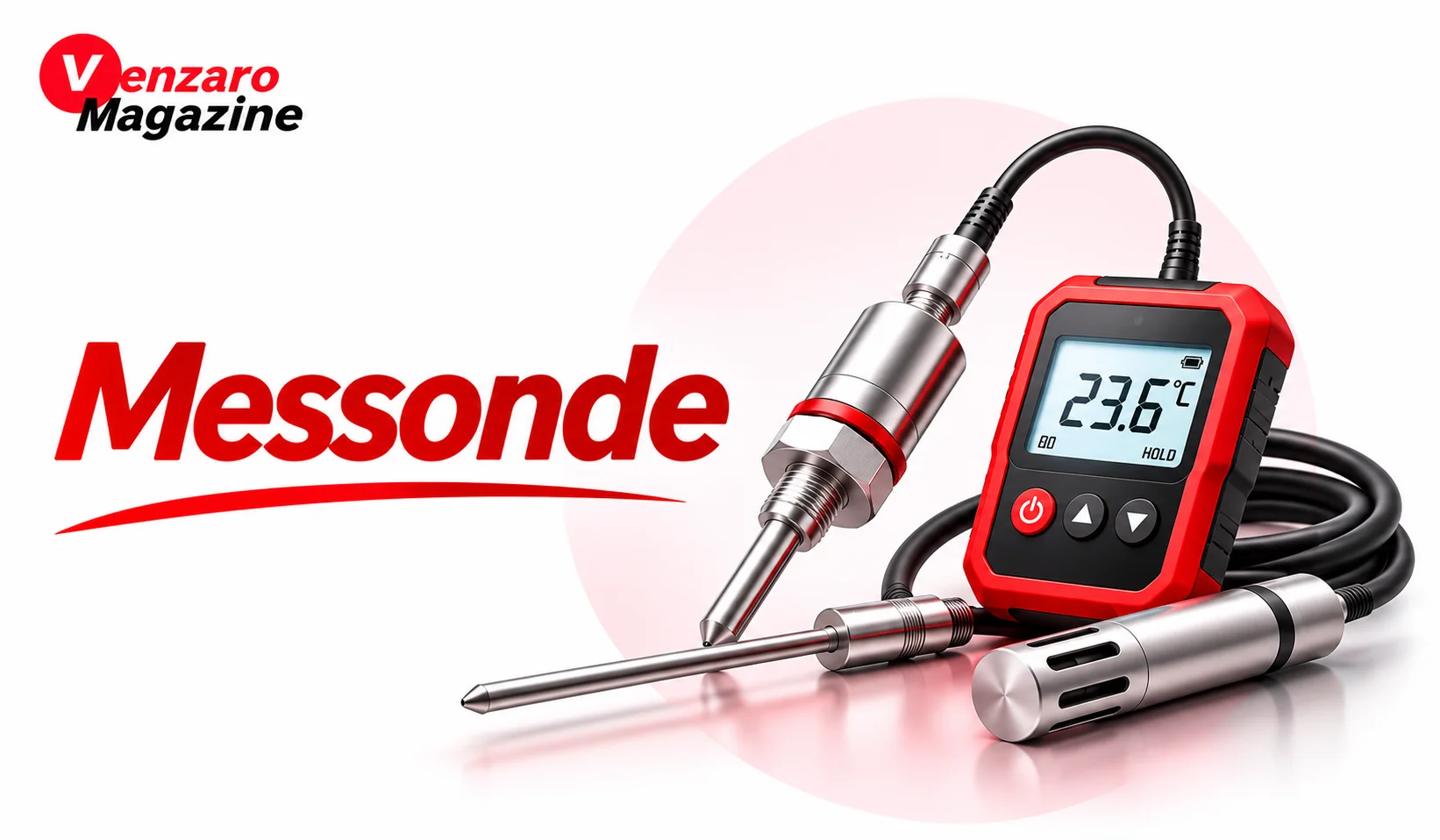




Messonde is an unusual search term that may refer to the German word Messsonde, which translates into English as a measuring probe. The spelling also exists independently online, where it has been associated with creativity, curiosity, and personal exploration. These interpretations have different origins and should not be confused with one another.
The technical meaning is particularly interesting because measuring probes perform essential tasks in environments ranging from household appliances to industrial manufacturing facilities. They allow people to examine conditions that cannot always be understood through ordinary observation.
Whether you encountered this expression in a technical document, an online discussion, or a product description, understanding its context is the easiest way to uncover its intended meaning.
The Third S That Changes the Whole Explanation
German vocabulary frequently combines smaller words to describe an object or its purpose. Messsonde follows this linguistic pattern, bringing together Mess, associated with measurement, and Sonde, meaning probe. The correct modern German spelling contains three consecutive letters S, which makes it slightly unusual for English-speaking readers.
Dropping one of these letters produces Messonde. This difference might appear insignificant, but it can lead search engines toward unrelated websites and explanations. Older German documents may also contain the spelling Meßsonde, reflecting earlier spelling conventions.
In engineering and scientific environments, the expression generally describes an instrument designed to detect or measure a particular condition. Its exact function depends on the equipment, sensing mechanism, and environment in which it operates. There is no single measuring probe capable of performing every measurement equally well.
What Happens Between Contact and Calculation?
Place a digital cooking thermometer inside a piece of food and watch the numbers change. Those changing figures represent a measurement process taking place inside a relatively small instrument. The temperature-sensitive component responds to surrounding thermal conditions, and the electronic circuitry converts that response into a readable value.
More sophisticated measuring probes work according to similar general principles, although their construction and sensing methods can differ substantially. Some respond to electrical resistance, others detect changes in pressure, and certain instruments use optical signals to examine materials or environmental conditions.
The probe usually serves as the connection between the physical environment and the equipment interpreting the measurement. Depending on its design, it may contain a sensing element, protective housing, electrical connections, or specialized components that improve measurement stability.
The accuracy of the final reading depends on the entire measurement system. Even a high-quality probe can produce unreliable information when positioned incorrectly or connected to unsuitable equipment.
Different Questions Require Different Instruments
A technician investigating an overheating motor has a different measurement requirement from a scientist examining water quality. Although both may use equipment described as a Messsonde, their instruments are designed around entirely different physical or chemical properties.
Common measuring probe categories include:
- Temperature probes: Measure thermal conditions in liquids, gases, surfaces, or solid materials.
- Pressure probes: Detect pressure within pipes, containers, and mechanical systems.
- pH probes: Determine the acidity or alkalinity of liquid solutions.
- Humidity probes: Examine moisture conditions in air or specific materials.
- Electrical probes: Assist in measuring voltage and other electrical properties using compatible instruments.
- Optical probes: Use light-based techniques to detect or examine selected characteristics.
Choosing an appropriate instrument involves identifying what needs to be measured before considering how the measurement should be performed. A device designed for laboratory conditions may not withstand the vibration, moisture, or extreme temperatures encountered inside an industrial facility.
The Invisible Work Behind Everyday Comfort
Measurement technology rarely receives attention when everything functions correctly. A heating system maintains a comfortable room temperature, a refrigerator keeps food cold, and manufacturing equipment produces components with consistent dimensions. Behind many of these processes are sensors and measuring instruments providing information to control systems.
Agriculture offers another practical example. Soil moisture probes help growers understand whether the ground contains sufficient water. Surface appearance alone can be misleading because dry-looking soil may retain moisture beneath its upper layer. Measurements taken at suitable depths provide additional information that can support irrigation decisions.
Environmental monitoring stations use specialized probes to examine water temperature, dissolved oxygen, conductivity, and other conditions. These readings help researchers understand changes within natural ecosystems and investigate potential environmental problems.
The usefulness of such equipment lies in its ability to turn otherwise invisible conditions into information that people can examine, compare, and act upon.
Why Two Probes Can Disagree About the Same Thing
Imagine placing two thermometers inside the same container of water and discovering that their readings differ slightly. This does not necessarily mean that one instrument is broken. The difference could result from calibration, sensor response time, positioning, or the measurement limitations of each device.
Calibration involves comparing an instrument’s readings against a suitable reference to establish how closely its measurements correspond to known values. Over time, environmental exposure, component aging, and physical damage can affect measurement performance.
Precision and accuracy are also different concepts. An instrument may repeatedly produce nearly identical readings while remaining consistently different from the actual value. Such an instrument demonstrates good repeatability but may require calibration or adjustment to improve accuracy.
For professional applications, understanding measurement uncertainty is equally important. Displaying several decimal places does not automatically make an instrument more reliable. The quality of the reading depends on the equipment’s capabilities and the circumstances under which the measurement was taken.
Reading the Specifications Instead of the Sales Description
Someone purchasing measuring equipment may encounter impressive technical terminology without receiving a clear explanation of whether the instrument suits their requirements. A useful product description should provide measurable specifications rather than vague promises about superior performance.
Several characteristics deserve particular attention:
- Measurement range: The minimum and maximum values the equipment supports.
- Accuracy specification: The stated limits of measurement error under defined conditions.
- Response time: How quickly the instrument reacts to changing conditions.
- Material compatibility: Whether the probe can withstand contact with the intended substance.
- Operating conditions: Suitable temperature, pressure, humidity, and environmental limits.
Connection compatibility also matters. A probe may require a particular controller, signal processor, or measurement device to function correctly. Purchasing an instrument without checking these requirements can create unnecessary expenses.
For specialized industrial applications, installation instructions and maintenance requirements are just as important as the original purchase price.
When Messonde Has Nothing to Do With Instruments
Not everyone searching for this keyword is interested in engineering. The exact spelling also appears at Messonde.com, where it is presented as an invented expression connected with discovery and personal experiences.
Within this interpretation, the name belongs to a creative discussion rather than a scientific classification. It can be associated with exploring unfamiliar ideas, developing interests, or questioning established assumptions. Its significance comes from the meaning assigned to it by the website rather than a documented linguistic tradition.
There is no established connection between this philosophical interpretation and German measurement technology. Treating them as separate subjects helps readers avoid attributing scientific capabilities to an abstract idea or assigning invented cultural origins to a technical instrument.
Could Messonde Be an Emerging Technology?
The word itself does not establish the existence of a new technological invention. Measuring probes already form part of numerous established scientific and industrial systems, with designs continuing to develop alongside improvements in electronics, materials, and data processing.
Wireless measurement systems, for instance, can transmit readings without requiring a permanent wired connection between every measurement point and monitoring station. Other instruments are designed for continuous observation, allowing operators to identify gradual changes that might be missed during occasional manual inspections.
Miniaturization has also made certain measurement systems suitable for environments where larger instruments would be impractical. These developments belong to the broader field of sensing and measurement technology rather than a distinct technological category officially called Messonde.
Readers encountering claims about revolutionary products under this name should examine the actual manufacturer, technical documentation, and intended application before drawing conclusions.
Three Questions Worth Settling
Is Messonde an English dictionary word?
It does not have a widely established English dictionary definition. Its most identifiable technical association is with the German term Messsonde, although the shorter spelling has also been adopted as an independent online name.
Are measuring probes and sensors identical?
Not necessarily. A sensor detects a physical or chemical property, while a probe may contain that sensor alongside protective materials, connections, and additional components. The terminology sometimes overlaps depending on the industry and instrument design.
Can one measuring probe handle several measurements?
Certain multiparameter instruments can measure several properties using multiple sensing elements. However, ordinary single-purpose probes are generally designed around specific measurement requirements.
Putting the Word Back Into Its Proper Context
The most sensible way to understand Messonde is to examine where it appears. In technical documentation, it may represent a spelling variation of the German expression for a measuring probe. On a creative website, it may carry a meaning chosen by its publisher.
The distinction is small in spelling but substantial in purpose. One interpretation belongs to the practical science of obtaining reliable measurements, while the other concerns ideas and personal expression.
Knowing that difference allows readers to identify the information they actually need without becoming distracted by unrelated definitions. Sometimes, understanding an unfamiliar word begins with something as simple as noticing a missing letter.