








Imagine living in a world where almost everything about you exists somewhere on a computer. Your conversations, finances, personal information, and daily activities leave digital traces that companies and institutions can collect. Now imagine someone with the technical ability to access those systems and the determination to challenge the people controlling them.
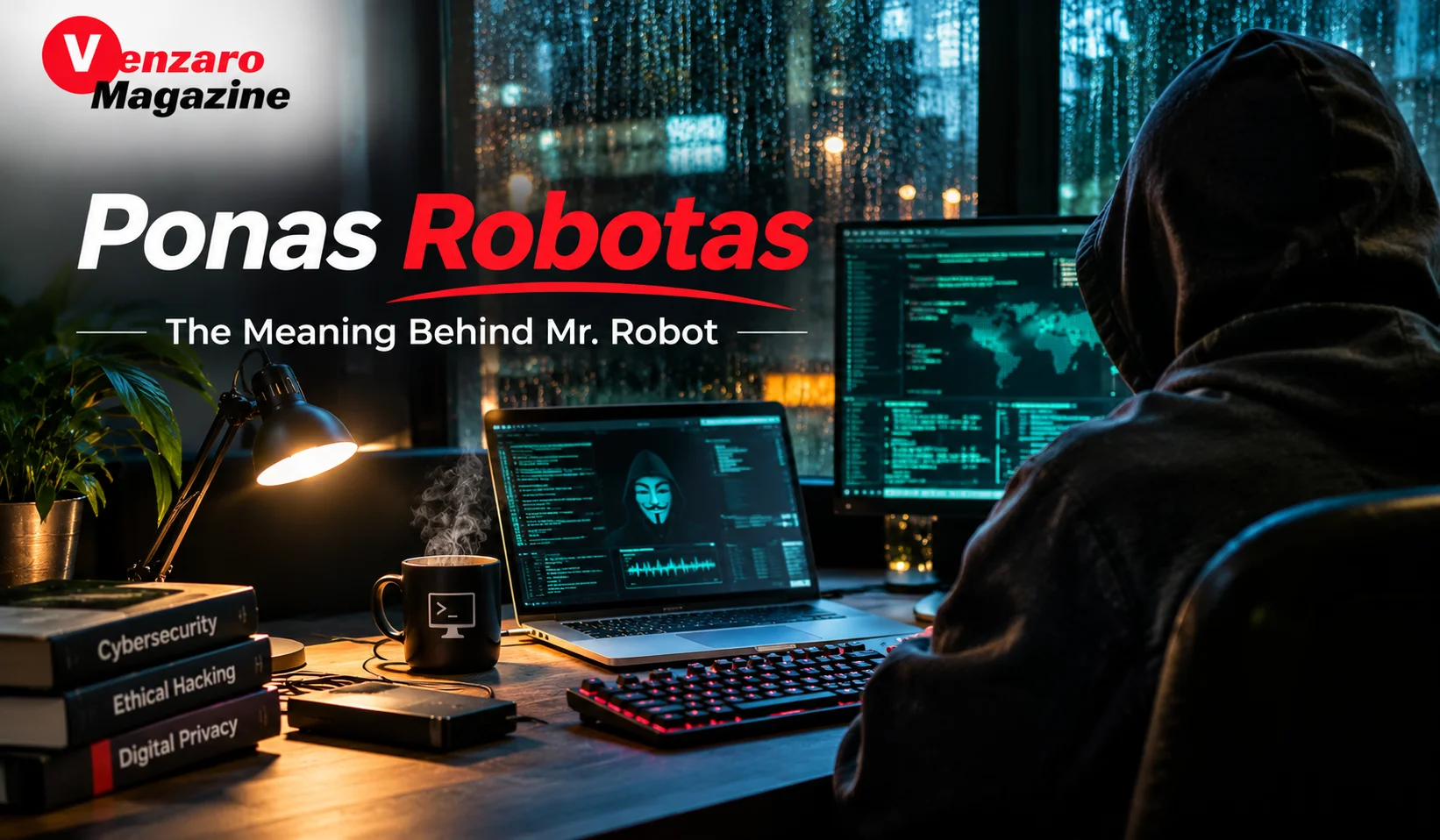
That unsettling possibility sits at the heart of Ponas Robotas, the Lithuanian title associated with the American television series Mr. Robot. Created by Sam Esmail, the psychological technology thriller follows Elliot Alderson, a talented cybersecurity engineer whose unusual perspective on society draws him into a dangerous movement against corporate power.
Although the title may sound like a reference to a futuristic machine, Ponas Robotas is not primarily a story about physical robots. It explores hacking, identity, mental health, economic inequality, and the uncomfortable relationship between technology and personal freedom. Its combination of technical detail and psychological storytelling makes it particularly interesting to viewers who enjoy narratives that challenge their assumptions.
The Lithuanian Name That Leads to an American Psychological Thriller
The phrase Ponas Robotas comes from Lithuanian, where ponas means “mister” or “sir,” while robotas translates to “robot.” Together, the words form the equivalent of the English title Mr. Robot.
This translation appears in Lithuanian television and entertainment listings, allowing local audiences to recognize the American production under a familiar-language title.
The series originally aired on USA Network and ran for four seasons, beginning in 2015 and concluding in 2019. Rather than following a conventional crime-drama format, it combines cybersecurity incidents with psychological mysteries that become increasingly complicated as the story develops.
Its creator, Sam Esmail, uses unusual camera framing, unreliable narration, and carefully controlled reveals to make viewers experience uncertainty alongside the central character.
The result is a series in which the audience must constantly reconsider what it knows about the people and events on screen.
Elliot Alderson Is Not Your Typical Television Hero
At the center of Ponas Robotas is Elliot Alderson, portrayed by Rami Malek. Elliot works as a cybersecurity engineer at Allsafe Cybersecurity, a company responsible for protecting organizations from digital threats.
Outside his professional life, however, he uses his technical abilities to investigate people, uncover private information, and intervene in situations he believes are unjust.
Elliot is highly intelligent, observant, and technically capable, but his personal life is complicated by isolation, emotional difficulties, and struggles with his perception of reality.
His character challenges the familiar image of the confident television hero. He frequently doubts himself, distrusts powerful institutions, and feels disconnected from the social expectations surrounding him.
One distinctive storytelling choice is his direct communication with the audience. Elliot often addresses an unseen companion, allowing viewers to experience his private thoughts.
This technique creates an unusually personal relationship between the character and the audience, although the reliability of his perspective becomes an important part of the narrative.
A Mysterious Stranger Offers Elliot a Dangerous Opportunity
The story takes a dramatic turn when Elliot encounters a mysterious figure known as Mr. Robot, portrayed by Christian Slater.
Mr. Robot introduces Elliot to fsociety, an underground hacker collective seeking to challenge a powerful multinational corporation called E Corp.
The group believes that the corporation represents a financial system that concentrates power among a small number of influential institutions.
Their proposed solution involves attacking digital financial records in an attempt to disrupt the existing economic structure.
At first, the plan appears connected to a larger argument about inequality and corporate control. However, the consequences become more complicated as the story progresses.
What begins as a seemingly straightforward conflict between hackers and a powerful company develops into a narrative involving political influence, personal motivations, and difficult ethical decisions.
The series repeatedly raises an uncomfortable question: even when someone believes their goal is justified, does that make every method of achieving it acceptable?
Why the Hacking in Ponas Robotas Feels Different
Many television productions portray hacking through flashing screens, unrealistic graphics, and characters who can break into complex systems within seconds.
Ponas Robotas takes a more grounded approach.
Its technical sequences incorporate recognizable cybersecurity concepts, including social engineering, phishing, malware, network vulnerabilities, and digital surveillance.
The show also emphasizes that successful attacks frequently exploit human behavior rather than sophisticated programming alone.
A stolen password, convincing message, poorly protected account, or trusted employee can sometimes create opportunities that technical defenses fail to prevent.
This attention to detail makes the series appealing to viewers interested in cybersecurity.
Nevertheless, the show remains fictional entertainment. Certain operations are compressed, dramatized, or adapted to serve the story. Its portrayal of hacking should not be mistaken for a complete technical explanation of real-world cybersecurity practices.
The Characters Who Make the Digital Conflict Personal
Although Elliot dominates the narrative, Ponas Robotas gains much of its emotional depth from the people surrounding him.
Angela Moss, portrayed by Portia Doubleday, has a personal history with Elliot and becomes increasingly involved in the corporate environment central to the story.
Darlene Alderson, played by Carly Chaikin, is a skilled hacker whose connection to Elliot and involvement with fsociety create several important developments.
Tyrell Wellick, portrayed by Martin Wallström, represents another side of the corporate world. His ambition, professional identity, and complicated personal motivations make him one of the show’s most unpredictable characters.
Dominique DiPierro, played by Grace Gummer, introduces an investigative perspective through her work as an FBI agent.
Each character offers a different response to power, fear, ambition, and personal responsibility.
Rather than treating the supporting cast as background figures, the series allows their individual choices to influence the direction of the larger conflict.
The Real Conflict Isn’t Always Happening on a Computer Screen
One of the most distinctive features of Ponas Robotas is the way it connects external events with Elliot’s internal experiences.
The series examines how memory, perception, and psychological distress can influence someone’s understanding of reality.
Elliot’s experiences are central to the storytelling, but they should not be viewed as a universal representation of people living with mental health conditions.
The narrative uses psychological uncertainty to shape what viewers know and when they discover it.
This technique makes apparently ordinary conversations feel significant. Small details in dialogue, background settings, and character behavior can acquire new meanings as additional information emerges.
The show rewards careful attention because some of its most important revelations depend on events that initially appear unremarkable.
Four Seasons That Gradually Change the Meaning of the Story
Ponas Robotas contains four seasons, each expanding the consequences of the events introduced earlier.
The first season establishes Elliot’s character, his relationship with Mr. Robot, and the activities of fsociety. It introduces the major conflict while leaving several questions deliberately unanswered.
The second season explores the aftermath of those events and places greater emphasis on psychological uncertainty. Its pacing and narrative structure differ noticeably from the opening season.
The third season increases the intensity of the conflict, bringing together corporate influence, hacking operations, and the consequences of earlier decisions.
The fourth and final season moves toward resolving the major character arcs and mysteries that have shaped the story.
Watching the seasons in order is essential because seemingly minor events can influence later developments.
The series is not designed around independent adventures. It tells a connected story in which understanding the present often requires remembering something from the past.
How Ponas Robotas Turns Technology Into a Question About Freedom
Beyond its central mystery, the series explores the influence of digital systems on modern society.
Large institutions store enormous quantities of personal and financial information. This creates convenience, but it also concentrates responsibility and potential power in organizations controlling those systems.
Ponas Robotas examines what might happen when such power is challenged through unauthorized digital activity.
The series does not present every hacker as a hero or every corporation as a simple villain. Instead, it explores how motivations, consequences, and competing interests complicate apparently straightforward conflicts.
Its fictional events encourage viewers to consider questions about privacy, economic dependence, cybersecurity, and the limits of individual control.
These themes remain relevant because digital services continue to influence communication, employment, banking, and everyday decision-making.
The Visual Details That Make the Series Feel Uncomfortable
Ponas Robotas has a distinctive visual identity.
Characters are frequently positioned near the edges of the frame, leaving large empty spaces around them. This unusual composition can create feelings of isolation, vulnerability, or emotional distance.
The lighting and locations also contribute to the atmosphere. Offices, apartments, subway stations, and city streets often appear cold or impersonal.
Music and sound design add another layer of tension, sometimes making an ordinary conversation feel more unsettling than an action sequence.
These creative choices support the central character’s experiences without requiring constant explanation.
For viewers who appreciate cinematography and carefully constructed visual storytelling, the series offers more than an interesting plot.
Questions Viewers Commonly Ask About Ponas Robotas
What does Ponas Robotas mean in English?
Ponas Robotas is a Lithuanian phrase that translates to “Mr. Robot” in English. It is used as a localized title for the American television series.
Is Ponas Robotas a separate Lithuanian television show?
No. The name refers to the American series Mr. Robot, created by Sam Esmail.
Who plays Elliot Alderson?
Rami Malek portrays Elliot Alderson, the central character. His performance earned him the Primetime Emmy Award for Outstanding Lead Actor in a Drama Series.
Is Ponas Robotas based on a true story?
No. The central storyline and characters are fictional, although the series incorporates recognizable cybersecurity techniques and real-world social concerns.
How many seasons does Ponas Robotas have?
The series consists of four completed seasons. Its main storyline reaches a conclusion in the final season.
Is the series actually about artificial intelligence or robots?
Not primarily. Despite its title, the series focuses on cybersecurity, psychological conflict, corporate power, and identity rather than humanoid robots or artificial intelligence.
Is Ponas Robotas appropriate for younger audiences?
The series contains mature subject matter, strong language, violence, drug-related themes, and psychologically disturbing scenes. It is primarily intended for mature viewers.
Why Ponas Robotas Leaves a Strong Impression After the Final Episode
Ponas Robotas begins with an intriguing premise about a cybersecurity engineer confronting powerful institutions, but its deeper appeal comes from the relationship between technology and human experience.
The series uses hacking as a gateway into questions about trust, personal identity, responsibility, and the ways individuals understand their own lives.
Its characters are rarely simple, and its most important conflicts cannot always be resolved through technical skill or clever planning.
More Read: Fastrac Ontrac: Understanding the Portal, Login Process, and Delivery Operations